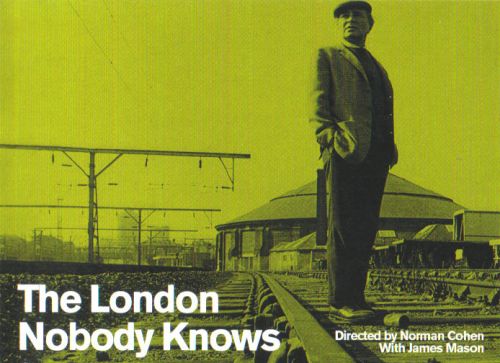
Widely regarded as one of the truly essential London films, the 1968 documentary The London Nobody Knows was based on a bestselling gazetteer-cum-memoir written by Geoffrey Fletcher, an illustrator and Daily Telegraph journalist.
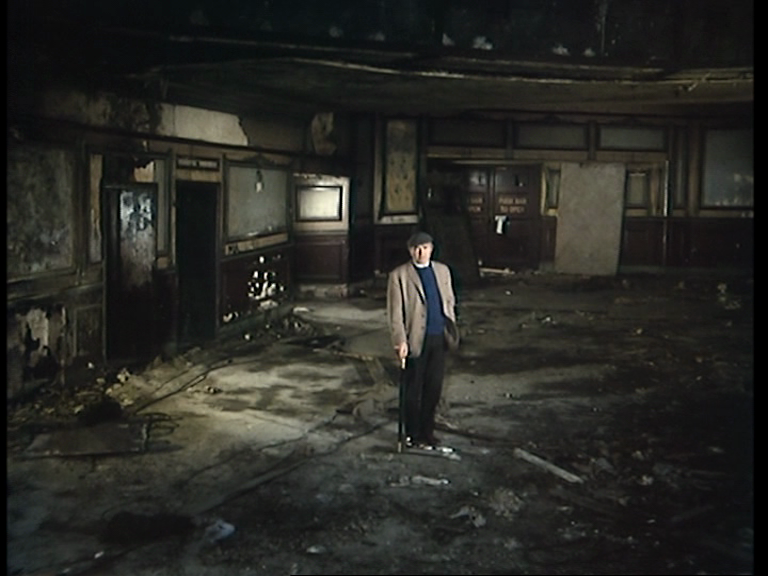
Directed by Norman Cohen (best known for later helming the long-running 1970s Confessions Of…sex comedy series), the 46-minute film features a melancholy James Mason leading an hour-long tour through the seamier streets of Swinging London, eschewing tourist sites for meths drinkers, shoeless children and bleak Victorian tenements.
Forty years after it was made, and after a decade of being the BFI’s single most requested title, The London Nobody Knows was finally released on DVD in 2008.
While Fletcher was billed as the film’s writer, the documentary was actually scripted by Brian Comport, who was only given a credit for “additional material” on commercial grounds. Now in his seventies and living in “sunny Brixton”, the dapper Comport is the only person involved in the film who has lived to see it acknowledged as a classic.
This is an interview I conducted with him, first broadcast on my old film show on Xfm.
How did The London Nobody Knows come to be made?
Norman Cohen, who produced and directed The London That Nobody Knows, had done four shorts for the Boulting Brothers and, as part of the deal he was on, had been offered a fifteen minute documentary. In 1966, he’d worked with James Mason on a film called The Blue Max as sound editor, had mentioned that he was thinking of doing this book as a documentary and Mason said “I’d love to do it.” That promptly raised money for another half hour. So Norman called me in. I was living on Bankside and I took him around, and he said “Right, go for it. Write me all this material.” So I did. He said “Look, the book on which it’s based is basically a point of departure, but the title The London Nobody Knows has got great marquee value, we’re sticking with that title because legally we have to, and as such, I’m going to have to acknowledge the author of the book, Geoffrey Fletcher.”

How much was Geoffrey Fletcher involved with the film?
Well, he wrote the book. He was a graphic artist, very good one, for the Daily Telegraph and exhibitions, and a bit of a history buff about London, a bit like Peter Ackroyd. He would have been, I suppose, a bit erudite for Norman when it came to the film. So I took it from there.
What was Fletcher like?
I never met the man. I read the book but I never met the man at all. He certainly knew his stuff as an artist and historian, though.
What was the reaction when the film was first released?
There was a very strange reaction to it. People didn’t know what to expect, frankly. Some people described it as ‘quirky’; some people described it as ‘quaint.’ Recently, someone called it an early fly-on-the-wall documentary, imitated since by television. At the time though, it was a very “Comme Ci, Comme Ça” reception – although we thought it might be a bit of a sleeper, and so it’s proved to be.

What’s do you put its enduring appeal down to?
I would say it was the humanity. Norman was a lovely man, had a great sense of mischief and he looked for characters – we filmed the kids, we filmed the olds and we filmed the down-and-outs. We took our lives in our hands in the really itchy part, where we had this evil-minded absolute raving animal of an alcoholic – poor devil – and we had a camera either side of him, knowing we’d have to be ready to drop them and just run if necessary.

Was the writing done during the filming process?
No, no, I’d written the material but when you get someone like James Mason, obviously if he wants to extemporise, that’s entirely down to him! Norman would have been a fool to have it any other way. So, no, the script was written before.
So there’s no treasure trove of unused material that one day will come to light?
I doubt it. There’s an out-cut that I don’t think will ever see the light of day, as I don’t think it was printed off. We were on Tower Hill with the escapologist.

Mason was talking on a prompt from my script, and he happened to mention in passing about being a Cockney, which I am – born in the sound of Bow Bells, in Cheapside. And this bloke breezed in, camera running, “’Ere, Mr. Mason, now, let me correct yew on that small matter. The Bow in question is ver Bow down in Poplar, right? It’s not anywhere else.” Mason was flummoxed – he was so urbane, gentlemanly, and polite – and Norman leant over to the cameraman and just whispered “Let it run! Just let it run!” But then he had cold feet and we canned it, so I don’t think it saw the light of day in any physical sense, and it’s not likely to ever turn up.
It’s astonishing watching someone the stature of James Mason walking through the rough streets of London and the commotion it causes.
Oh, it did! He had a driver and I would share the car occasionally, and he was standing with my partner at the time, when a little girl came up to her and said “’Ere, if that’s Mr. Mason, are you Mia Farrow?” They assumed anyone near him was famous too.

Considering the muted critical reception, I presume there were no plans for a follow-up, despite Fletcher writing more London titles.
Well, Norman went on to do ‘Til Death Us Do Part and Dad’s Army, and I did two or three more movies, and so that was it. It was an early point in his career and in mine. I was very fond of all the films I later made, but I was always particularly fond of London. Norman was a great mate, and it’s very moving, a lot of it.
Are you surprised by the level of acclaim it’s enjoying after forty years?
I must say I am, but I think it a thoroughly decent picture, and I’m sorry that Norman isn’t here to enjoy the accolades. I feel like a broom in a broom cupboard, that someone’s wondered what it’s doing in there, has brought it out and finally put it to good use. When I saw the film again the other day, I was very pleased with it. And that’s a very nice feeling.
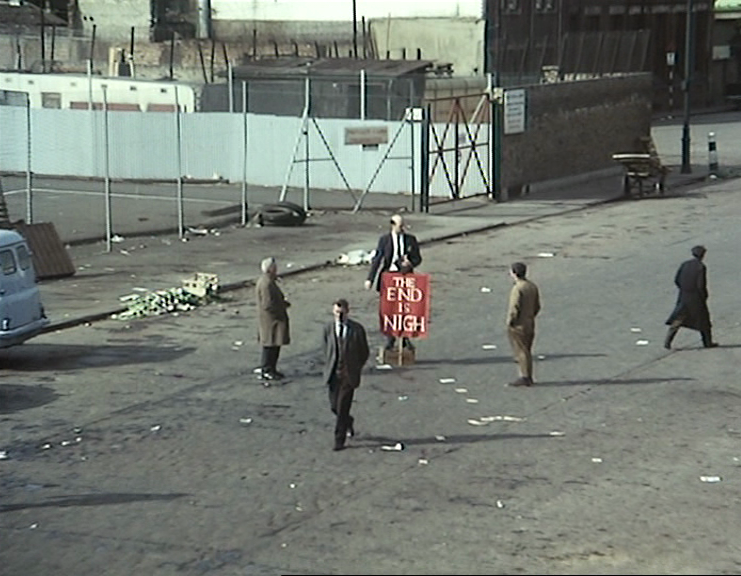
The London Nobody Knows is available as an Optimum Classic DVD as part of a double-bill with Les Bicyclettes de Belsize, and is available here and here (I’m only making life easier if you want a copy – I don’t have any association with these vendors.)
The documentary is also up on YouTube, but it probably shouldn’t be for sorts of copyright issues. The quality isn’t a patch on the DVD.
Patrick Caulfield’s grave in Highgate
May 4, 2011
While everyone knows Highgate Cemetery is full of interesting and noteworthy monuments, I didn’t stumble across this one until 2009.
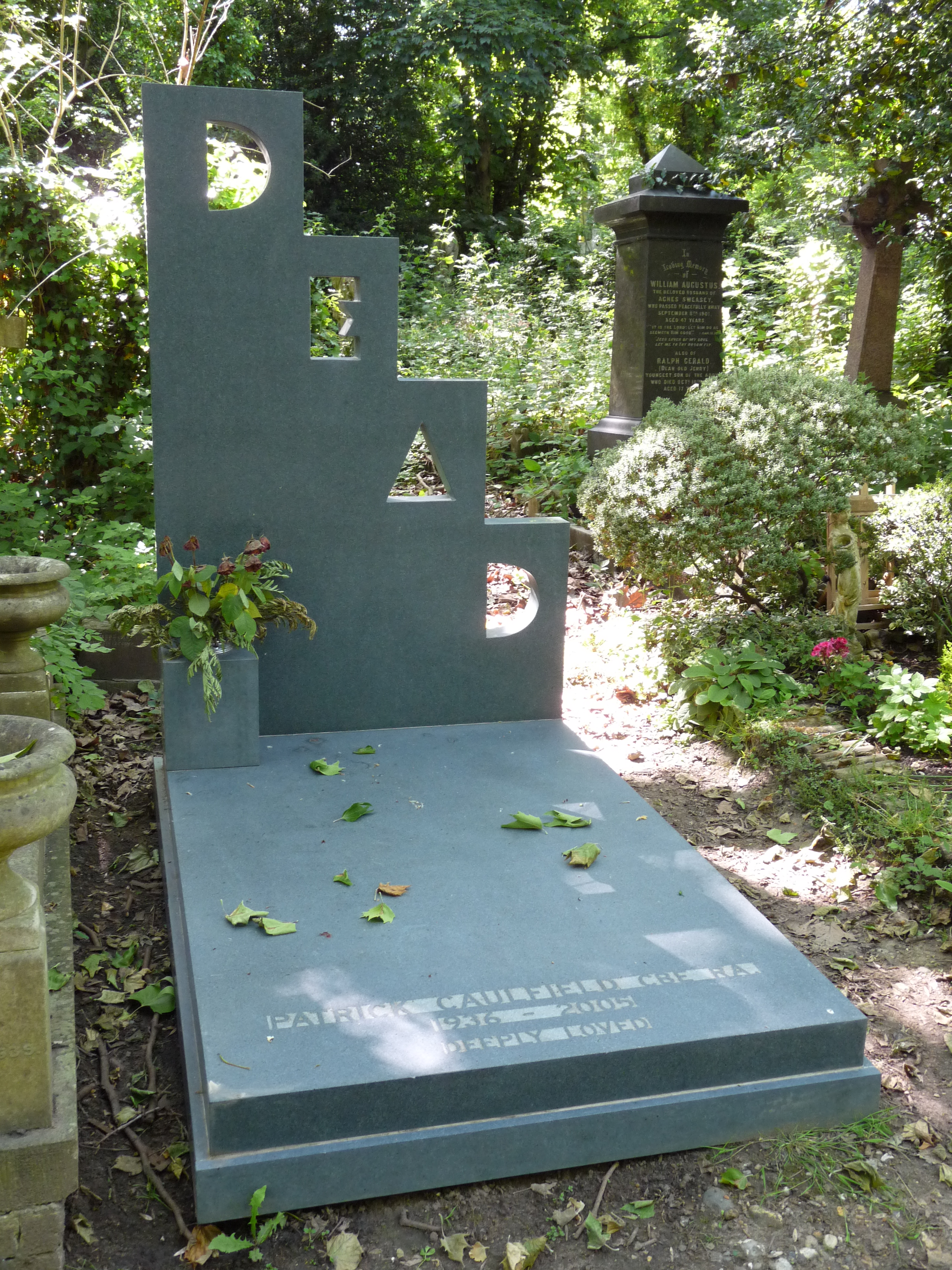
It’s genuinely a surprise when you stumble upon it – you rarely see the word ‘dead’ celebrated in a graveyard, let alone spelled out in huge laser-cut letters on a six-foot slab of granite.
The painter and print-maker Patrick Caulfield (1936-2005) was a contemporary of David Hockney. Regarded as part of the Pop Art movement. and a Turner Prize nominee in 1987, Caulfield designed the memorial which now sits on his grave.
There’s lots of Caulfield’s work available to see online, but if you fancy seeing the grave, it’s in the east side of Highgate Cemetery – down the central road, and almost to the railings at the very end.
Cafe Classique, Colindale
May 4, 2011
It’s long gone now, but here’s a photo I took of Cafe Classique in Colindale back in about 2002. Just outside the tube station on Colindale Avenue and next to the shop dedicated solely to Airfix models (a much sadder, more recent loss), it was the only place near the British Library’s newspaper archive to go for something for lunch.
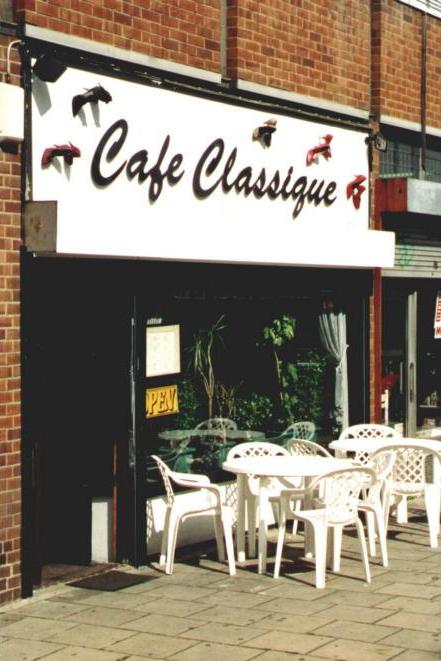
The women’s shoes nailed to the sign might put some people off, but if that didn’t work, someone had also blu-tacked a couple of porn photos up in the gentlemen’s toilets.
The people working behind the counter never seemed very happy to serve, took orders and money begrudgingly and there was always a worrying sense that some of the women who worked there might also be on the game. The academics and writers who’d come out for a break in their research would look terrified the second they crossed the threshold, and they’d always eat quickly, in silence, and get out as soon as possible. There was a constant sense of tension and fear in the room that the employees seemed to actively encourage.
For entirely explicable reasons, Cafe Classique ended up closing down a couple of years later. I took this photo quite early on, but as the months and seasons passed after I’d snapped it, the shoes started to get incredibly tatty – covered in bird shit, torn up, faded in the sun, puckered by the rain. It became the most melancholy looking cafe you’d ever seen in your life.
The shop sign always reminded me of Mike Leigh’s Life is Sweet, where Timothy Spall opens up a restaurant serving dishes like liver in lager which has too many themes going on at once. The shoes are an attempt at panache that overreaches, entirely misses and ends up being excruitiating. And Cafe Classique – I mean, they nailed women’s shoes to the front. What were they thinking?
It’s like some kind of serial killer’s grisly trophy display. You might as well have put scalps up there, or necklaces of teeth.
There is still a cafe on the site today, but, disappointingly, it’s entirely nondescript.
UPDATE – February 2012
Sometimes, the places you’ve always half-wondered about have a history just waiting to be revealed. In February, I was emailed by Ebru, who it turned out knew the cafe well.
I have been crying with laughter reading your musings on the cafe that was indeed classique!
This was my dad’s cafe.
When we saw the shoes and porn and undies nailed to the wall, we were like “WTF!” There is soo much that went on in there, I had forgotten about the black and white classy porn that was hanging in the toilets…
To be fair to my dad, it was an inspirational time for him: he was having an affair with one of his Czech waitresses (she was quite nice), I think he wanted to impress her.I even had a blazing row with him there: I asked for £40 and for the first time he said ‘no’. I started screaming at him and told him to shove his money and spend it on some knickers for his girlfriend… knowing him, he would have nailed a satin twinset to the wall.
He had a cafe in South Oxhey before Colindale. His sexuality was hidden under the counter: he would cut out the Sun’s topless girl everyday and keep it there. I’d have a look through them (interested in what they had to say) and there was a stack! Started recognising them after a while, I was around 10… Brother and myself turned out ok, but it didn’t work out with the Czech girl.He now lives with his brother in Grahame Park (not so much stillettos… more like Werther’s Originals and freedom passes).Thank you for writing about it on your blog. It’s nice to know that his overt sexuality was appreciated by others.
The Men Who Wrote Shakespeare
May 4, 2011
Whether one believes a barely-educated glove-maker’s son from Stratford-Upon-Avon could produce the greatest single body of literature in the history of the world or not (and if you want to find yourself unsure, John Mitchell’s excellent Who Wrote Shakespeare? (1996) will give you plenty of conspiracy food for thought), one fact is unassailable: the man known as Shakespeare didn’t write the plays which we can pick up and read today.
That’s not to say the words weren’t his – but if William Shakespeare ever physically wrote any of those words down, nothing has survived. Instead, the plays we know today as ‘Shakespeare plays’ are the work of two men who have been largely forgotten: the actors John Heminge and Henry Condell.
I say ‘largely forgotten’, but in the City churchyard of St Mary Aldermanbury, EC2, is a memorial dedicated to them both.
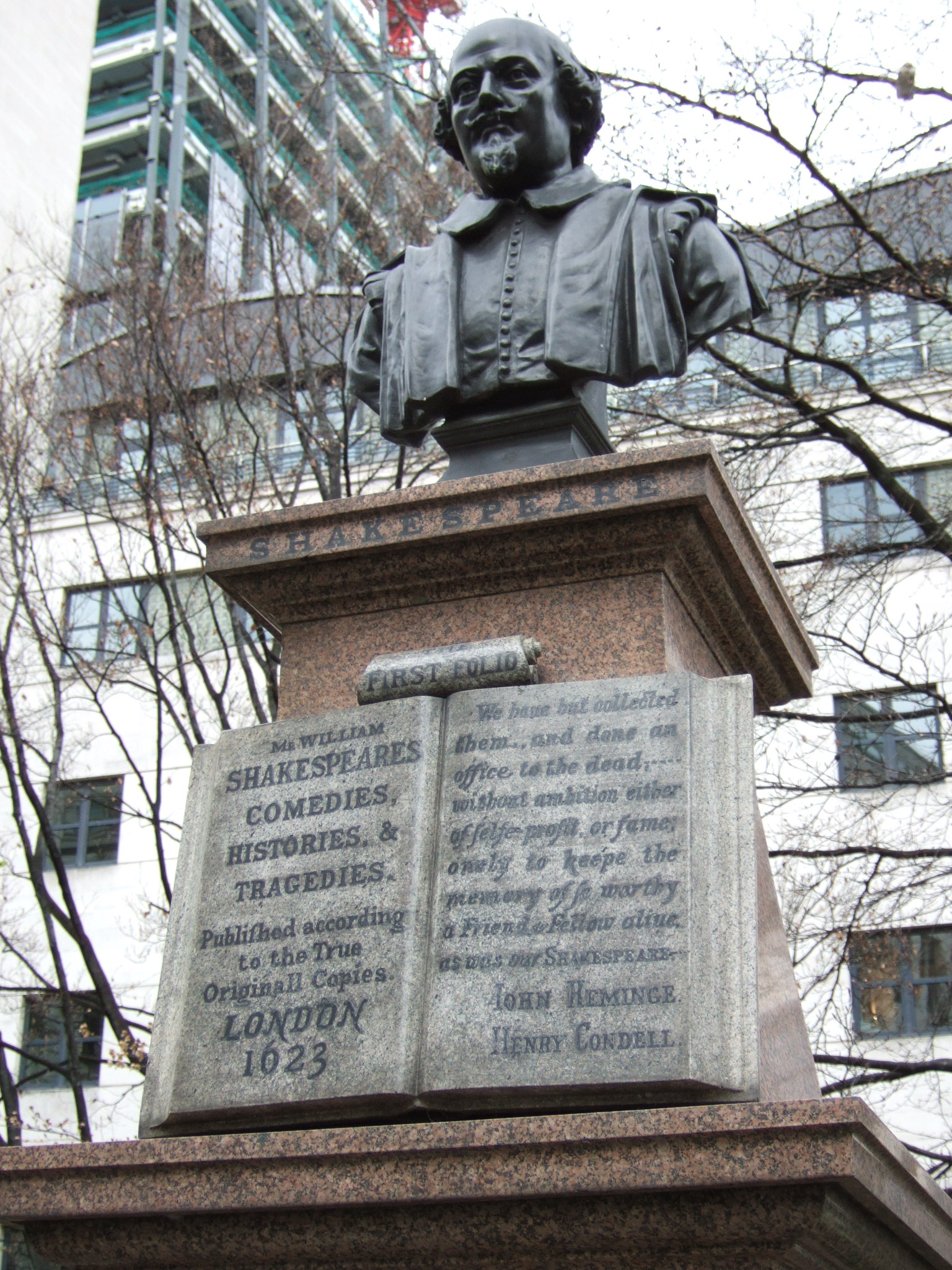
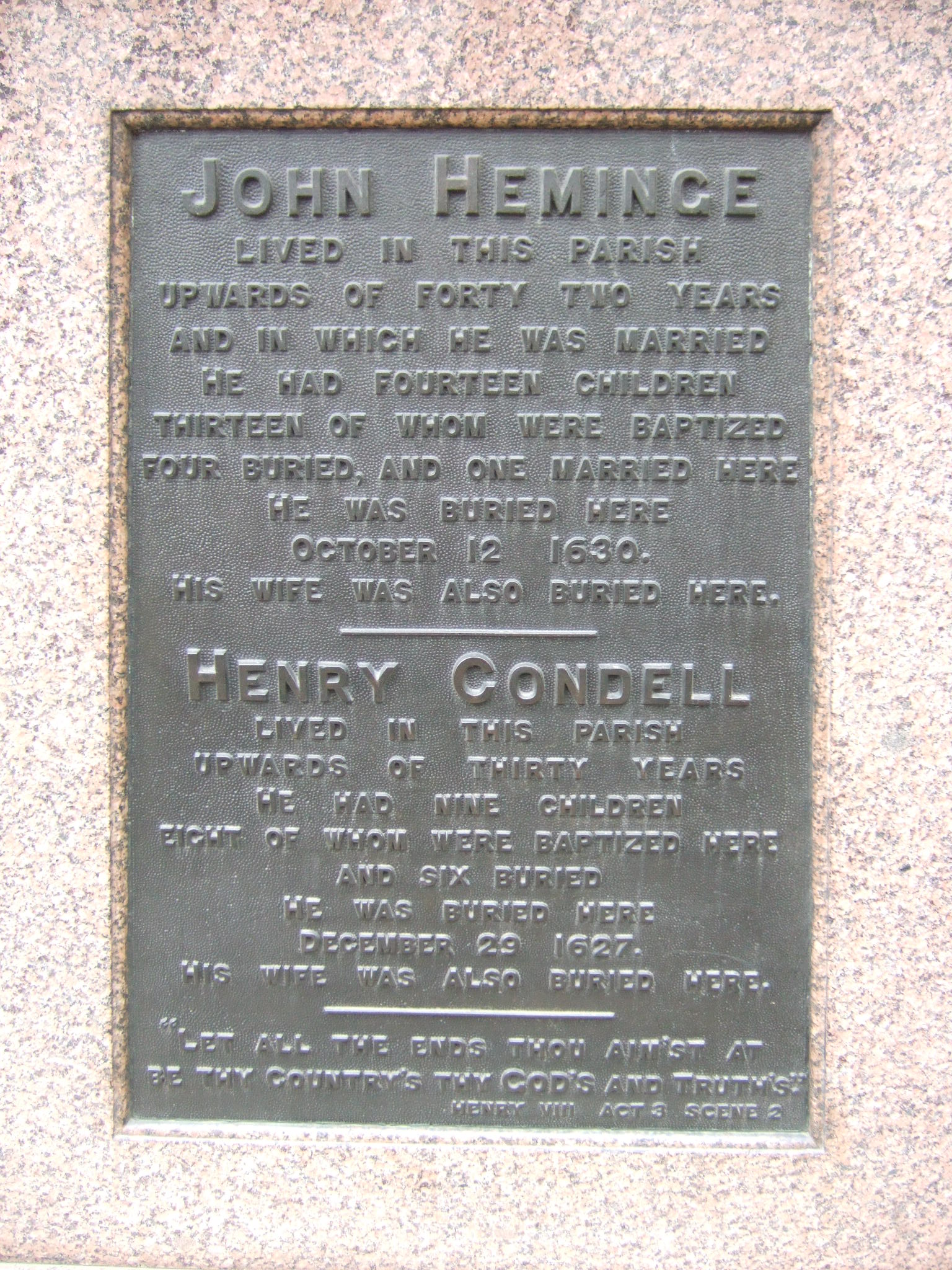
While the bust of Shakespeare sits proudly on top of the memorial, the plaques on the main body are dedicated to Condell and Heminge.

The text reads:
To the memory of JOHN HEMINGE and HENRY CONDELL, fellow actors and personal friends of SHAKESPEARE. They lived many years in this parish and are buried here.
To their disinterested affection the world owes all that it calls SHAKESPEARE. They alone collected his dramatic writings, regardless of pecuniary loss and without the hope of any profit, gave them to the world.
THEY THUS MERITED THE GRATITUDE OF MANKIND.
The two were Shakespeare’s co-partners at the Globe theatre in Southwark, and on his death in 1616
from the accumulated [plays] there of thirty five years, with great labour selected them. No men then living were so competent having acted with him in them for many years, and well knowing his manuscript, they were published in 1623 in Folio, thus giving away their private rights therein. What they did was priceless, for the whole of his manuscripts with almost all those of the dramas of the period have perished.
There’s no question of an authorship controversy here. The two men state unequivocably that Shakespeare was the author of the plays at a time when many of his contemporaries were still alive. It is one of the strongest refutations ofthe idea Shakespeare was not their author.
If it wasn’t for Heminge and Condell, the works of Shakespeare could have been lost to the world forever. They were the fine thread between us having the work of the world’s greatest writer and it being lost entirely.
How different the world would be if they hadn’t sat down one day, with a pile of dusty papers and half-remembered passages they’d performed a decade before, and thought, “Well, maybe we should try and get the lot of them written down for posterity.” It starts to make me feel ill at the thought of the great works that have been lost forever simply because there was no Heminge or Condell around to save it.
Everytime someone performs a Shakespeare play, there should be a round of applause at the start for the men who ensured that Shakespeare’s words survived.
The Church of St Mary Aldermanbury no longer stands, but was first mentioned in 1181 and rebuilt by Sir Christopher Wren following the Great Fire of London in 1666. Bombed during the Second World War, the stones were removed in 1966, shipped to America, and the church was rebuilt in the grounds of Westminster College in Fulton, Missouri. It was erected as a memorial to Winston Churchill, who had given his famous ‘Iron Curtain’ speech in the Westminster College gymnasium in 1946.
David Thomson – In Camden Town (1983)
May 4, 2011
I first came across David Thomson’s In Camden Town a couple of years ago as bite-sized entries in a London anthology book. Thomson’s tightly wrought street reportage stood out like a beacon amidst the other more florid and familiar entries, so I kept an eye out for the book whenever I popped into a second-hand book shop. After a fruitless year of searching, I turned to Abebooks, where I picked up a battered second-hand copy for a couple of quid.
Put simply, it’s an enthralling work about London by a largely forgotten, hugely talented writer.

Born in 1914, Thomson worked as a writer, researcher and BBC radio producer, writing three novels, a book about animal folklore, and a number of children’s books for Puffin, such as Danny Fox, Danny Fox Meets A Stranger and Danny Fox At The Palace. In 1955, he and his wife moved to Regents Park Terrace in Camden to bring their three sons up.
In 1980, at the age of 66, he was attempting to complete a vast, sprawling history of Camden Town. Struck with writer’s block at the sheer immensity of the project, he started to keep a diary.
He thought that forcing himself to write short entries each day would help break the deadlock, as well as “bypass for a time my dread of opening the manuscript at the page where I left off.” About halfway through his diary, he attempted to restart the book, but found himself in tears after just six lines. Returning to his new manuscript later in the day, he found the page he had been working on had been torn out – only he couldn’t remember having done so, nor could he remember what he’d written.
The book he ended up publishing instead was the diary – a wide-ranging vivid often beautiful, often bad-tempered account of life in Camden Town, as he writes, drinks and struggles with work.
He spends days roaming through Camden, describing the horrors and the dirt that he passes – “Canal black, with plastic cups floating on it, potato-crisp bags, Kentucky chicken and, I think, a dead cat” – popping into the pubs along the way, and passing hours chatting to the tramps, drunks and chancers who he runs into on a regular basis.
Thomson frequently writes about a Scottish alcoholic named Davy and his on-off partner Mary. He’d known them both for twenty years,
but only been on speaking terms with him since Christmas Eve in 1975…Davy came up to me and said that the off-licence was shut and would I go into the pub and get some cider. He had some little coins in his hand to encourage me. They are not allowed in anywhere and only into one cafe that I know of. I got the cider and some Guinness for myself and we went to drink it on a bench near the Buck’s Head where in those days they liked to sit in the sun facing the end of Inverness Street market. No market that day. Beautiful sun, but weak. Mary and Davy were surprised that I felt cold. They spend their lives in such places.
Elsewhere, Thomson talks with passion on the conditions that navvies worked under on the railways into Euston (a topic that he would have covered in his never-completed history) – in the course of his research, he discovered a record of a woman who’s lost twenty-nine of her partners in six years, and only one of them to natural causes.
Thomson starts to despise the fact he’s getting old, tells how he once smelled what he thinks were “ghost horses” at some traffic lights at Henley’s Corner, talks about how the smell of bonfires rouse old memories, and decides that the Punk fashion (this being 1980) he sees outside The Music Machine venue is akin to Puritanism – “it is startling to see such a look of severity, especially on the girl’s faces in the evening outside a pleasure dome, but this I guess is fashion too.”
He attends a sparse funeral in East Finchley for a pauper (“I felt I was in a desolate housing estate among minature houses for the dead”) and relates how even as an elderly man, he still always sat near attractive women on buses.
If it’s a girl with long hair down her back…I clasp the hand rail on the back of her seat. That’s what it’s meant for I suppose, but I’ve never seen anyone else clasp it. And as she moves her head her hair touches my hands….I just haven’t changed since I was fifteen. I learn from autobiographies that people do change.
Published by Hutchinson, and later in paperback by Penguin, the book was reviewed favourably at the time by The Guardian and The TLS, so it seems quite surprising that David Thomson is almost totally obscure today. His memoir Woodbrook (concerning a period in the 1930s where he tutored two girls in a rural Irish country house and ended up staying for ten years) is better known, but Thomson’s work has largely fallen out of the public eye.
Seamus Heaney wrote an introduction for a reissue of Thomson’s collection of seal folktales The People Of The Sea in 2001, and much of what he says about that ‘luminous’ book could equally apply to In Camden Town .
He refers to “the sweetness and intimacy of David Thomson’s imagination,” saying the book follows “his own creative, truth-telling bent with characteristic unpredictability and sprightliness.” Oddly, it sounds all very high-falutin’ until you’ve read In Camden Town, and the spikiness, the strangeness and the vividness that Heaney talks of can be spotted immediately.
The fact Heany’s comment applies equally to a book about living in a run-down North London district, as it does to a book about ancient Celtic seal fables, is purely down to the sheer brilliance of Thomson’s writing.
It’s a shame that this book has been totally forgotten, and it’s a shame that David Thomson seems to have been totally forgotten too. It’s something neither of them deserve.
The Painted Lady of Soho
May 4, 2011
Back in 2009, there was a little lady nicknamed Soho Pam who walked around Soho most nights asking for change. If you gave her some, she’d often ask if you wanted to buy a picture of her for a bit extra. I did. She told me that someone had come up to her in the street, asked if he could paint her and she agreed. When it was done, she took a photo of the finished result, and ordered loads of reprints from the negative.
If you give her a couple of quid, you get a picture of the lady you just gave it to.
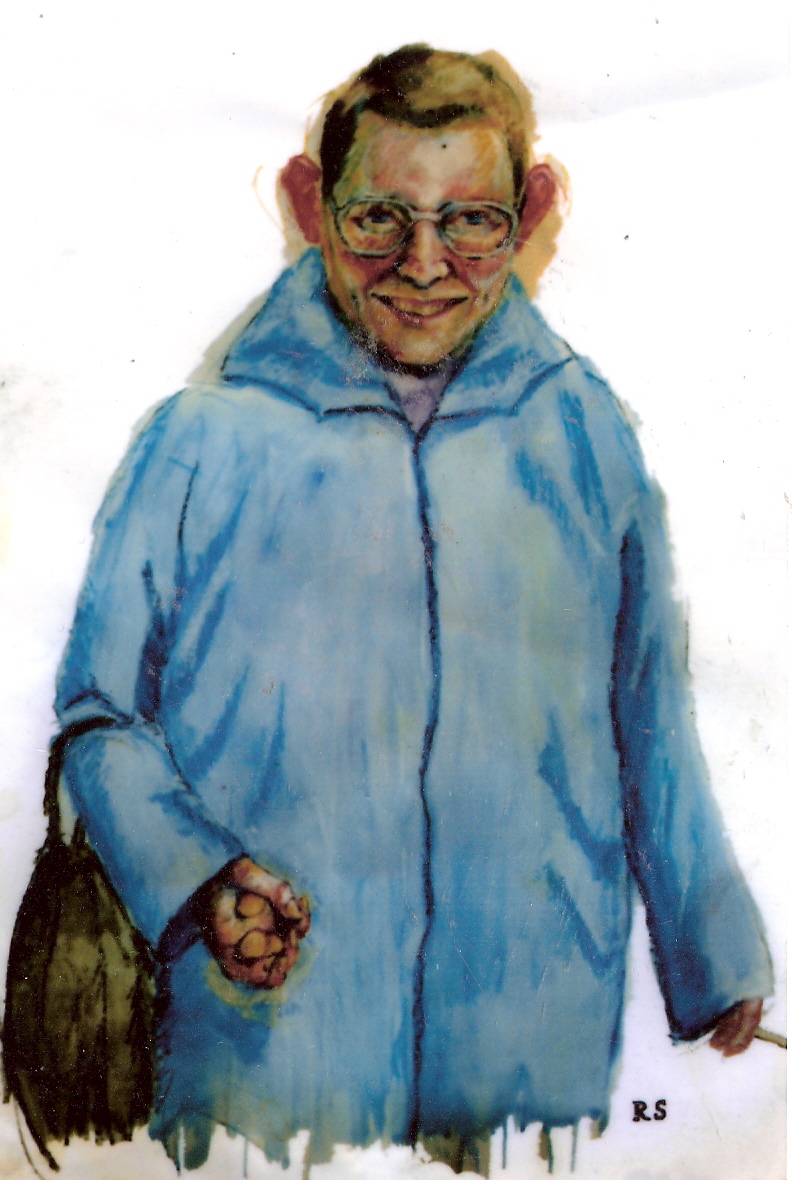
Everyone should do this – if someone does you a favour, give them a painting someone’s done of you. That way, over time, they’d end up with a visual record of all the people they’d ever been nice to, and when they’re old, they can warm their cockles looking over their gallery.
Update: It was reported in early January 2013 that Soho Pam, the lady who handed out these photos, had died. Over the years, she had become one of Soho’s most familiar street faces – anyone stepping outside for a smoke on a night out would almost be guaranteed to have Pam bobble over at some point to cadge some change. The photo below comes from a Twitter account in her name.

Here’s the Telegraph’s obituary of Pam from January 2013.
 Darkest London