Sound Tour of London
May 25, 2011
Years ago, I picked up this single in a charity shop – but sadly just the sleeve. With no record inside, the actual recording of Sound Town: London – The West End remains a tantalising mystery. It’s undated, but the inclusion of the BT Tower (which was completed in 1964) on the sleeve means it was released in the mid-1960s at the earliest.

Produced by Travelsound of 1-14 Canfield Gardens, NW6 (a couple of roads away from Finchley Road tube station), the record celebrates “the sounds that are London. A small treasure of knowledge this – it will enrich you in many ways, help you to understand the people of this Island. You will then be able to say, “nice to know you.””
I’d always presumed it would consist of field recordings of noises, ambient sound or conversations – a prototype art project – but looking at the back, one T.Z. Kurkowski is credited with the script, which was read by Ian Clark, a registered British Travel Association guide. In some ways, it’s an early prototype of many of the modern London walking tours you can currently download through iTunes, where someone takes you on a walk in real time, their commentary running over the sounds of the roads they’re walking down and the sights they stop outside.
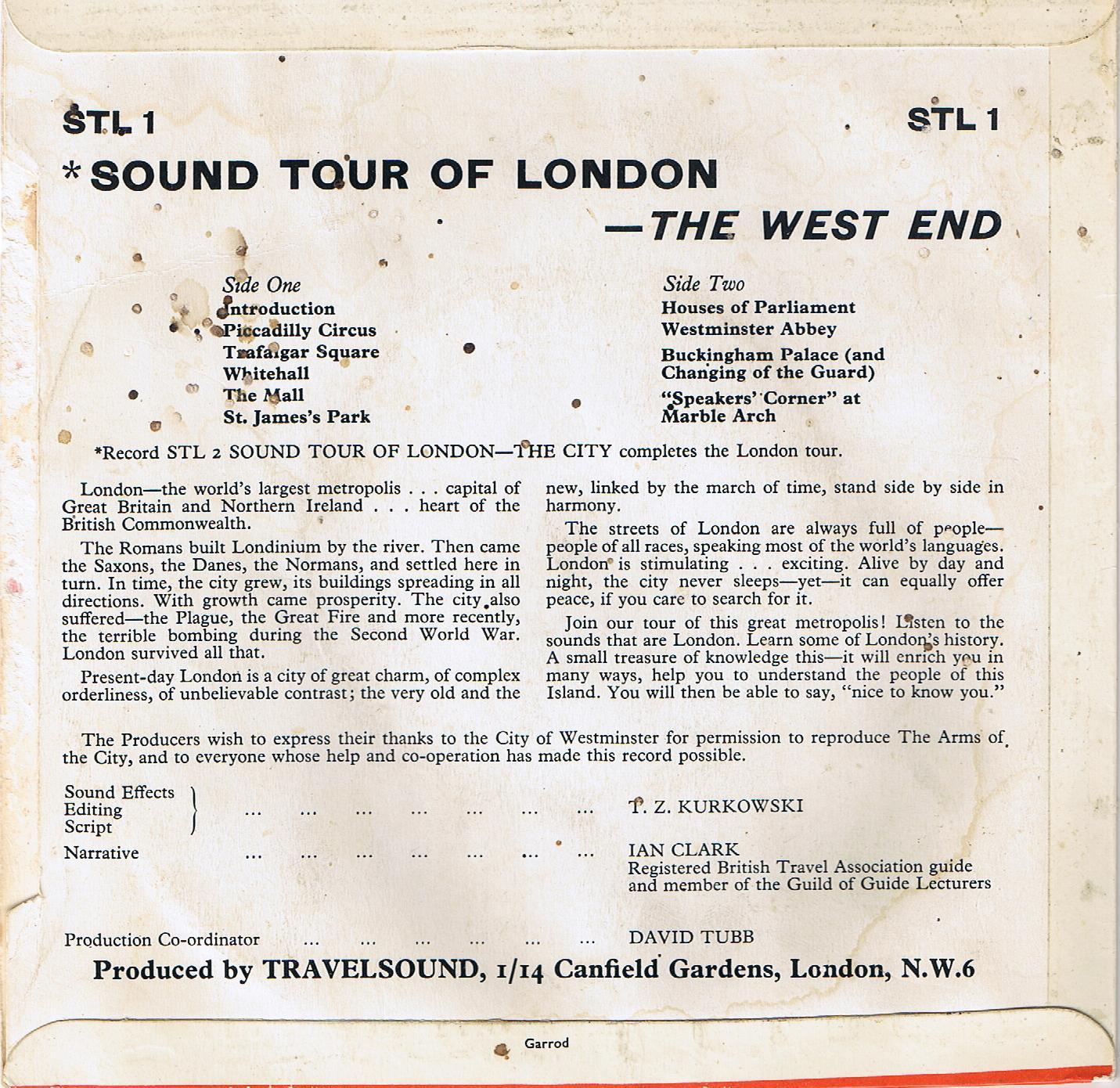
The track ‘Speaker’s Corner at Marble Arch’ is the one I’m keenest to hear – for something which has been running for so many years, it’s shocking how meagre a selection of recordings seem to have been made at Speaker’s Corner. In recent years, it seems to have fallen off the list of tourist destinations, but having wandered over a few months back, it’s as full of racists, cranks and End-Is-Nigh-ers as ever.
A second record – Sound Tour of London – The City – was also released at the same time, but neither return any results on the internet whatsoever. It seems I’m never going to get to hear this thing…
The Oxford Street beavers
May 6, 2011

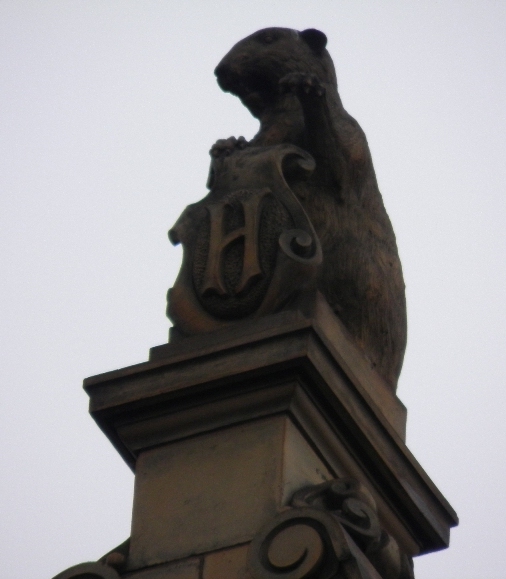
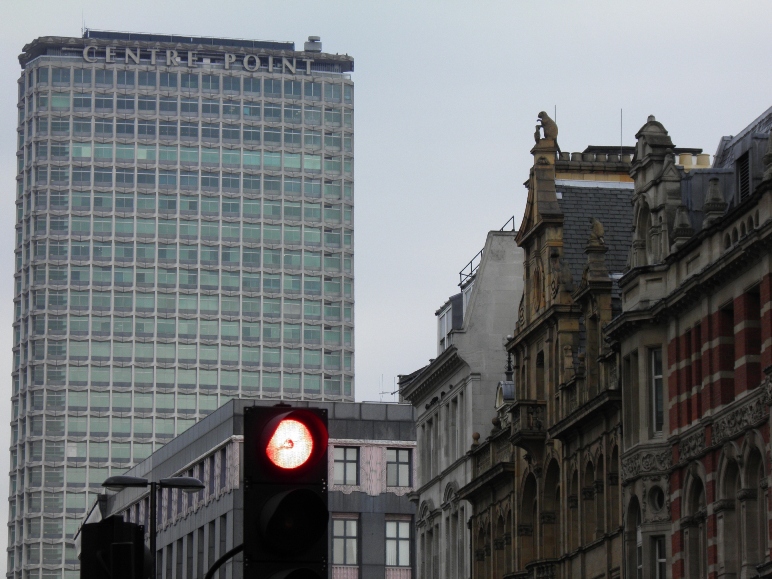
High above 105-109 Oxford Street sit a trio of London’s oddest statues.

Three stone rodents.
At first glance, they look a bit like rats, but the wide flat tail sported by the one on the right identifies them as beavers.

The one at the very top also comes with a scroll, bearing the initial ‘H’.
105-109 Oxford Street was formerly the premises of Henry Heath’s Hat Factory, and his name and profession are still spelled out in a brick facade on the back of the old factory, which can be seen from Berwick Street.

According to the firm’s own publicity in 1879, Heath’s hat factory dated back to the reign of George IV (1820-1830) and they guaranteed “1st , Their Quality; 2nd Excellence of Finish; 3rd Style.”

A relief of George can be seen above one of the windows, with the date 1822 most likely referring to the firm’s establishment. Next to it is a young Queen Victoria, 1887 being the date the premises were rebuilt.
Henry Heath’s primary product was top hats, which were made using felted fur from “Beaver Otter, Rabbits, Hares and Musk Rats.”
 A Henry Heath flyer from an 1884 exhibition
The firm was still advertising its products in 1931, but while they undoubtedly shut up shop due to the modern decline in hat-wearing, I’ve been unable to find out exactly when. If anyone knows, please drop me a line!
In the meantime, here’s a final shot of the beavers, who’ve been perched on the roof watching London change for the last 124 years.
The house of Jack The Ripper
May 6, 2011
It might be more proper to place a question mark at the end of that headline, but, according to Stephen Knight’s Jack The Ripper: The Final Solution (1985), 74 Brook Street, just two minutes away from Oxford Street and opposite Claridge’s, was once the home of London’s most infamous murderer.

Knight first identified the Victorian surgeon William Withey Gull (1816-1890) as Jack the Ripper in his book, and his hypothesis was later adopted by Alan Moore for the tremendous graphic novel From Hell (which was also a less tremendous film.)
 Dr William Withey Gull, c.1860
Educated at Guy’s Hospital (where he remained throughout his professional career) Gull’s medical reputation has been entirely outstripped by the clamour of the Ripperologists. He coined the name ‘anorexia nervosa’, advanced understanding of paraplegia and Bright’s disease, argued that women should be encouraged to enter the field of medicine, and was known for his ceaseless work in treating patients at any time of day or night.
Gull’s surprisingly modern medical outlook was summed up in his Published Writings: “Never forget that it is not a pneumonia, but a pneumonic man who is your patient. Not a typhoid fever, but a typhoid man.”
In 1871, Gull became Physician-in-Ordinary to Queen Victoria’s son Albert (then Duke of Wales and later Edward VII) and successfully treated him for typhus. With nary a full-stop in sight, The Times reported on Gull’s work with the Prince in December 1871:
In Dr. Gull were combined energy that never tired, watchfulness that never flagged ; nursing so tender, ministry so minute, that in his functions he seemed to combine the duties of physician, dresser, dispenser, valet, nurse, – now arguing with the sick man in his delirium so softly and pleasantly that the parched lips opened to take the scanty nourishment on which depended the reserves of strength for the deadly fight when all else failed, now lifting the wasted body from bed to bed, now washing the worn frame with vinegar, with ever ready eye and ear and finger to mark any change and phase, to watch face and heart and pulse, and passing at times twelve or fourteen hours at that bedside.
Created a Baronet the following year (he took the title 1st Baronet of Brook Street), Gull was consequently appointed Physician Extraordinary and subsequently Physician-in-Ordinary to Victoria. It is not likely he ever treated the Queen; there were four Physicians-in-Ordinary and for all but one of them it was effectively an honorary position.
Gull died at 74 Brook Street in January 1890 after a series of strokes. The Times reported his death.
We regret to announce that Sir William Gull died at half-past 12 yesterday at his residence, 74, Brook-street, London, from paralysis. Sir William was seized with a severe attack of paralysis just over two years ago while staying at Urrard, Killiecrankie, and never sufficiently recovered to resume his practice.
On Monday morning, after breakfast, he pointed to his mouth as if unable to speak. His valet, who was in the room, did not quite understand what was amiss, but helped him into the sitting-room. Sir William then sat down on a chair and wrote on a piece of paper, “I have no speech.” The family were at once summoned, and Sir William was soon after removed to bed, where he received every attendance from Dr. Hermann Weber, an old friend, Dr. Charles D. Hood, his regular medical attendant, and Dr. Acland, his son-in-law.
The patient, however, soon lost consciousness, and lingered in this state until yesterday morning, when he quietly passed away in the presence of his family. The inquiries as to his state of health during the last two days have been unusually numerous, a constant stream of carriages drawing up at the door.

Gull was buried next to his mother and father’s graves in his childhood hometown of Thorpe-le-Soken in Essex.
If his name was well-known in his lifetime, it was nothing compared to how famous it would become from the 1980s onwards. While a 72-year-old highly-respected baron doesn’t seem the most likely of serial killers, Stephen Knight’s hugely entertaining book argued that Gull was responsible for murdering five women working as prostitutes in the East End in 1888 on the direct orders of the state.
To do justice to the entire murky web of probable presumptions, possibilities and perhapses which make up this conspiracy, there’s nothing as exhaustive and enjoyable as Alan Moore’s From Hell.
The interior of 74 Brook Street even makes an appearance towards the end of Moore’s book, when the medium Robert James Lees leads the police investigator Abbeline to the doctor’s front door. A tired, confused Gull confesses to his crimes. This was just artistic licence on Moore’s part – but considering the entire “William Gull was Jack the Ripper” theory depends almost entirely on artistic licence to keep it afloat, it’s an entirely fitting addition.
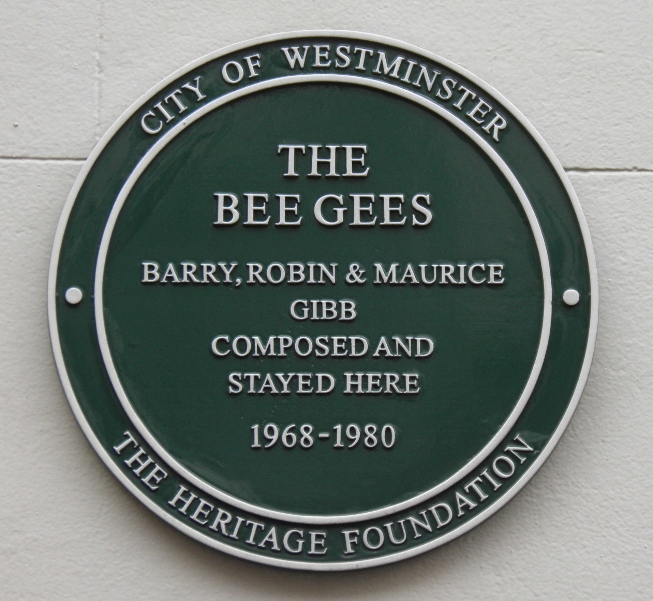
Surprisingly there is no plaque commemorating Gull’s time in the house, but there is one the other side of the road, on the house directly opposite 74 Brook Street.

The plaque is not dedicated to Dr Gull or Jack the Ripper, but commemorates some similarly grisly work that, even after all these years, still turns the stomach of all right-thinking people.
The Tramp Poet: WH Davies
May 4, 2011
There’s a strange synchronicity with second-hand books. Two days ago, I’d finished all the books I had on the go, so randomly picked out one I’ve owned for years and not read for ages: WH Davies’ 1908 The Autobiography of a Super Tramp. While I know he’s not using the word in the modern way, I love the idea he thought of himself as a “super tramp”, as opposed to just an adequate one.
Davies was a Welshman born in 1871. Regarded as a delinquent, with expulsions from school and trouble keeping jobs, he spent much of his early life living rough in America. While there, he lost a leg while riding the trains with a fellow tramp (in a foreshadowing of the loss of limbs, the other tramp’s name was Three-Fingered Jack) and for the rest of his life sported a wooden one.
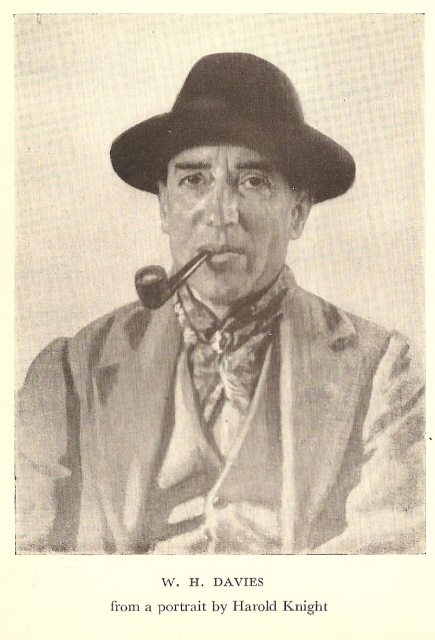
Destitute, he returned to England, where he lived in large doss houses in south-east London (including Southwark’s infamous Salvation Army hostel, known as The Ark) and sold shoe laces, saving his money with one single purpose: to self-publish his poetry.
In 1905, he sent his book of poems, entitled The Soul’s Destroyer, to George Bernard Shaw. “I get a gift of minor poetry once a week or so,” Shaw grumbled, but “before I had read three lines I perceived the author was a real poet.” Shaw was puzzled by what sort of man Davies was.
There were no author’s compliments, no publisher’s compliments, indeed no publisher in the ordinary channel of the trade in minor poetry. The author, as far as I could guess, had walked into a printer’s or stationer’s shop; handed in his manuscript; and ordered his book as he might have ordered a pair of boots. It was marked “price half a crown.” An accompanying letter asked me very civilly if I required a half-crown book of verses; and if so, would I please send the author the half-crown; if not, would I return the book. This was attractively simple and sensible.
Shaw bought eight copies, and when they were reviewed in a London newspaper, he discovered Davies was a tramp. Noting the review mentioned Davies had a manuscript of an autobiography, Shaw wrote back and offered to read it through. He was amazed by it.
All I have to say by way of recommendation of the book is that I have read it through from beginning to end, and would have read more of it had there been more to read…another effect of this book on me is to make me realise what a slave to convention I have been all my life. When I think of the way I worked tamely for my living during all of those years when Mr. Davies, a free knight of the highway, lived like a pet bird on titbits, I feel that I have been duped out of my natural liberty.
Having read the introduction to the autobiography two days ago, I’d started wondering what Davies’ poems were actually like. Today, browsing a small pile of old books in one of Finchley Central’s junk shops, I found a 1946 hardback of his collected work. That’s 48 hours between my wondering about them and subsequently having them in my hand. There’s a strange providence with second-hand books – somehow they start to find their way to you.

In all, Davies self-published fifty volumes of poetry, and this book collects all 636 of his poems.
He’s largely forgotten today – but his work’s not at all bad. Befitting his preoccupations as a tramp, Davies writes about outside spaces, his nights spent sleeping rough in the woods, his desire to have a house, about rogues who “come this day to borrow / A sum that’s promised but not paid tomorrow”, and portrays scenes of life from the lodging houses he frequented. One poem concerns a sailor in a doss-house shouting at his parrot for it’s foul language.
With his autobiography a success, Davies was immediately accepted by London’s literary and artistic circles (albeit more for his unusual life story than his work.) He was painted by Augustus John and in 1916 had a bronze made of his head by Jacob Epstein.
 WH Davies by Augustus John (National Museum of Wales)
In 1911, he was awarded a civil list pension of £50, which later increased to £100, and then £150. It meant he could live comfortably for the rest of his life and concentrate on his literary work. The same year, he coined his most recognisable (although often misquoted and rarely attributed) couplet in the poem Leisure:
What is this life if, full of care
We have no time to stand and stare…

A comfortable-looking Davies in 1913
In 1916, having lived for short periods in houses across London, Davies settled into a flat at 12 Great Russell Street (directly opposite the YMCA) with his pet toad, Jim.

He stayed at the flat until 1921 when he moved to 13 Avery Row, off Brook Street, in the smarter neighbour of Mayfair.
 Davies’s flat in Avery Row was one of the dark brick properties on the left
During his time in London, Davies occupied himself by writing a second volume of autobiography entitled Later Days and giving readings of his work; fourteen of his readings for the BBC reside in their archives.
Marrying in 1925, Davies and his wife left London for Gloucester. He died in 1940, the doctors telling him that his heart was showing alarming signs of weakness, which they attributed to his dragging the extra weight of his wooden leg about.
In his introduction to the collected poems, his friend Osbert Sitwell called Davies an
extraordinary and memorable being, who, for all his humility, bore about him something of the primitive splendour and directness of the Elizabethan age: in which, as his appearance testified, he would have been equally at home. No one who knew him will, or ever could, forget him, even had he never written so many lovely poems, fresh and exquisite as flowers to keep his memory alive; and no one who knew him will ever be able to recall him without a smile of pleasure and regret.
Sir John Squire summed up his poetry with a lovely turn of phrase:
Mr. Davies is astonished at everything the rest of us take for granted. What to the rest of us is the first primrose of spring is to him the first primrose in all the world. In other words, he is pure poet.
Open editions of Davies’ The Autobiography Of A Supertramp can be read in full here.
Stan Lee – Live at the Roundhouse 1975
May 4, 2011
In getting rid of all the stuff I’ve accumulated over the years, I came across this advert a couple of days ago in a British Planet Of The Apes weekly comic from 1975 – Stan Lee, live at the Camden Roundhouse.

He presented a slide-show, with tickets priced at 60p. I absolutely would love to see Stan Lee – I think as a writer, he’s one of the greats of the twentieth century. So many household names flowed out of his head in such a short span of time (about four years in the mid-60s, many of them in collaboration with the artists Jacky Kirby and Steve Ditko) – Spiderman, The Hulk, Thor, The X-Men, Iron Man, The Fantastic Four, Doctor Octopus (surely one of the greatest villain names ever?), Dr Doom, The Avengers, Daredevil, Dr Strange; the list just goes on and on.
It was about this time that the first comic shops started opening in London (one of the very first was Dark They Were And Golden Eyed, which moved around Soho throughout the seventies), but it’s sad to see how many of them have closed in the last decade. It’s a combination of the industry destroying itself in the 1990s by pandering to speculators and taking their eye off of stories, the growth of a few professionally-run shops (the Forbidden Planet was always number one by a long chalk, even when it was in a dusty, wooden-floored Denmark Street shop), and the fact that kids these days have more exciting things to do that open comics. They can play Fallout 3 for God’s sake, and given the choice between reading or killing mutant dogs, who can blame them?
I think Stan Lee might be the one single author whose work I’ve spent the longest time reading, and have enjoyed the most. He seems like a completely untortured, friendly, unpretentious genius, and he’s had more of an effect on global culture than pretty much anyone else in the last fifty years, and what’s more, in an entirely positive way.
I’d happily pay a lot more than 60p to see him do a slide show today. Hey, I’d pay more than 60p just to have him shout a trademark ‘Excelsior!’ right into my face.
The Astoria
May 4, 2011

On Wednesday, 14th January 2009, the Astoria at 157 Charing Cross Road closed its doors for the final time.
The whole corner block it stood on was compulsarily purchased for demolition, so Tottenham Court Road station (which is directly underneath it) could be made six times bigger in anticipation of the Crossrail project, a high-speed rail network linking Berkshire to Essex. Such a provincial sounding reason to spell the end of one of the very last (and certainly the largest) of the properly central large music venues.
Proper concert halls are one of the few things that never end up being replaced. Once they go, they’re gone for good, and it’s odd how once an area loses one, they almost never get one back.
Built on the site of an old Crosse and Blackwell pickle factory, the Astoria was designed by Edward A. Stone, who was also responsible for other Astorias in Brixton (now the Brixton Academy), Streatham and Finsbury Park. It opened in 1927 as a cinema, and continued screening films for the next fifty years. The picture below shows in it 1936.

The Astoria became a theatre in 1976, and finally a music venue sometime around 1985. The list of bands that have played there is a Who’s Who of the music industry since: Nirvana, Radiohead, Oasis, Blur, Madonna, U2, The Rolling Stones, Prince, Black Sabbath, David Bowie…an almost endless list. It makes me think that the legend engraved over the stage door of the Palace Theatre – I’m paraphrasing, but it’s along the lines of “the greatest artists in the world have walked through these doors, and will continue to do so” – would have fitted the Astoria.

While working for Xfm in August 2007, I did an on-stage introduction for the Fratellis and had a chance to nose about backstage (unfortunately, I’d left my camera at home.)
It was quite a state backstage – not in terms of being especially tatty (all concert venue backstages invariably are, no matter how plush they look from the outside), but because it was a mass of incredibly narrow tunnels and tiny, low-ceilinged corridors that twisted so often and so sharply, you felt that you weren’t going onstage so much as going caving. It really hits you when you walk out how big the auditorium is, mainly because the balcony is so steep, and it looks like it just goes up and up and up. My voice went too high when I shouted the band’s name, and that high-pitched ‘The Fraaaaatelllllis!” from my one time on the Astoria’s stage must have been played more on XFM than some of the regular station IDs. A proud moment.

Despite a number of spirited campaigns to keep it open, the final gig took place on the 14th January 2009. Appropriately named The Demolition Ball, the concert benefited a number of good causes, but the line-up of Get Cape Wear Cape Fly, The Automatic, My Vitriol and ex-Mansun singer Paul Draper was nowhere near the send-off the venue deserved.

A week after closing, the demolition job started in tiny increments – the sign for the Metro Club, round the other side of the building in Oxford Street, was taken down, and a few months later, the iconic signage of the Astoria were removed. By October 2009, the site had been levelled.
It’s demolition left just Koko (formerly the Camden Palace) and The Kentish Town Forum as the only similar-sized venues nearby, neither of which have the legitimately dirty, legendary, big-time feel of the Astoria.

It’s just a building that was there to make money, but I feel a bit sad it was knocked down. Maybe it was the amount of pleasure the Astoria brought to so many people (and I’ve been going to concerts there for over fifteen years, which I’m quite shocked to realise) that meant when I used to walk past it, I saw it as a ‘good’ place, a ‘friendly’ building. It was somewhere people looked forward to going inside. It had a sense of history that you felt when you stepped through the doors and started walking up the stairs.

And now it’s gone so we everyone can charge their Oyster cards up without having to queue, and get to Abbey Wood in Essex in much quicker time. Hooray.

Fitting with its iconic ‘big-time’ feel, there’s been a disproportionately large number of live shows recorded here for CD and DVD releases. You can see some of the acts (and hopefully what the venue used to look like in the background and cutaway shots of the DVDs) right here.
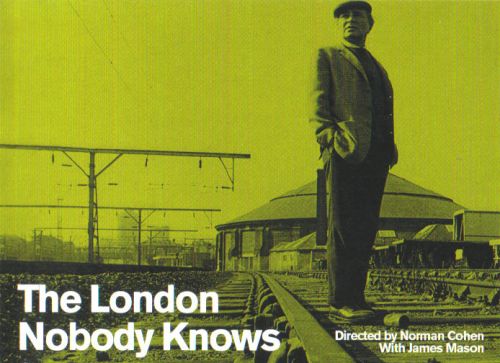
Widely regarded as one of the truly essential London films, the 1968 documentary The London Nobody Knows was based on a bestselling gazetteer-cum-memoir written by Geoffrey Fletcher, an illustrator and Daily Telegraph journalist.
Directed by Norman Cohen (best known for later helming the long-running 1970s Confessions Of…sex comedy series), the 46-minute film features a melancholy James Mason leading an hour-long tour through the seamier streets of Swinging London, eschewing tourist sites for meths drinkers, shoeless children and bleak Victorian tenements.
Forty years after it was made, and after a decade of being the BFI’s single most requested title, The London Nobody Knows was finally released on DVD in 2008.
While Fletcher was billed as the film’s writer, the documentary was actually scripted by Brian Comport, who was only given a credit for “additional material” on commercial grounds. Now in his seventies and living in “sunny Brixton”, the dapper Comport is the only person involved in the film who has lived to see it acknowledged as a classic.
This is an interview I conducted with him, first broadcast on my old film show on Xfm.
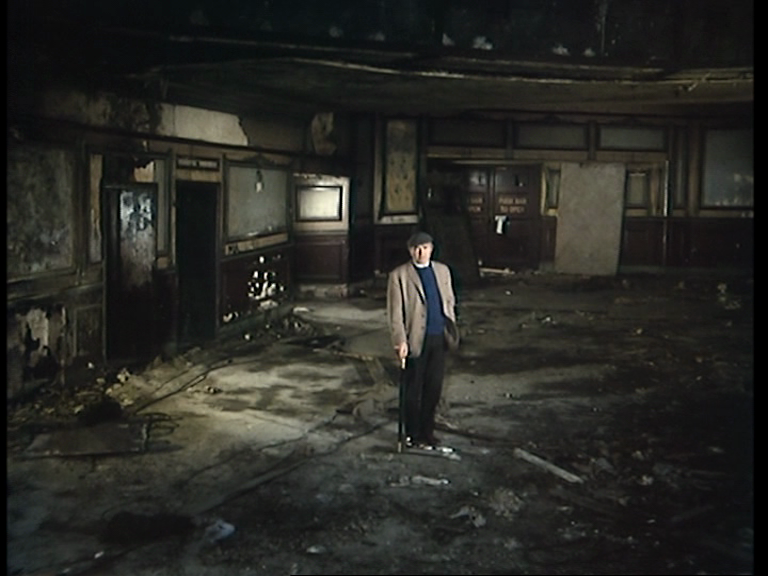
How did The London Nobody Knows come to be made?
Norman Cohen, who produced and directed The London That Nobody Knows, had done four shorts for the Boulting Brothers and, as part of the deal he was on, had been offered a fifteen minute documentary. In 1966, he’d worked with James Mason on a film called The Blue Max as sound editor, had mentioned that he was thinking of doing this book as a documentary and Mason said “I’d love to do it.” That promptly raised money for another half hour. So Norman called me in. I was living on Bankside and I took him around, and he said “Right, go for it. Write me all this material.” So I did. He said “Look, the book on which it’s based is basically a point of departure, but the title The London Nobody Knows has got great marquee value, we’re sticking with that title because legally we have to, and as such, I’m going to have to acknowledge the author of the book, Geoffrey Fletcher.”

How much was Geoffrey Fletcher involved with the film?
Well, he wrote the book. He was a graphic artist, very good one, for the Daily Telegraph and exhibitions, and a bit of a history buff about London, a bit like Peter Ackroyd. He would have been, I suppose, a bit erudite for Norman when it came to the film. So I took it from there.
What was Fletcher like?
I never met the man. I read the book but I never met the man at all. He certainly knew his stuff as an artist and historian, though.
What was the reaction when the film was first released?
There was a very strange reaction to it. People didn’t know what to expect, frankly. Some people described it as ‘quirky’; some people described it as ‘quaint.’ Recently, someone called it an early fly-on-the-wall documentary, imitated since by television. At the time though, it was a very “Comme Ci, Comme Ça” reception – although we thought it might be a bit of a sleeper, and so it’s proved to be.

What’s do you put its enduring appeal down to?
I would say it was the humanity. Norman was a lovely man, had a great sense of mischief and he looked for characters – we filmed the kids, we filmed the olds and we filmed the down-and-outs. We took our lives in our hands in the really itchy part, where we had this evil-minded absolute raving animal of an alcoholic – poor devil – and we had a camera either side of him, knowing we’d have to be ready to drop them and just run if necessary.

Was the writing done during the filming process?
No, no, I’d written the material but when you get someone like James Mason, obviously if he wants to extemporise, that’s entirely down to him! Norman would have been a fool to have it any other way. So, no, the script was written before.
So there’s no treasure trove of unused material that one day will come to light?
I doubt it. There’s an out-cut that I don’t think will ever see the light of day, as I don’t think it was printed off. We were on Tower Hill with the escapologist.

Mason was talking on a prompt from my script, and he happened to mention in passing about being a Cockney, which I am – born in the sound of Bow Bells, in Cheapside. And this bloke breezed in, camera running, “’Ere, Mr. Mason, now, let me correct yew on that small matter. The Bow in question is ver Bow down in Poplar, right? It’s not anywhere else.” Mason was flummoxed – he was so urbane, gentlemanly, and polite – and Norman leant over to the cameraman and just whispered “Let it run! Just let it run!” But then he had cold feet and we canned it, so I don’t think it saw the light of day in any physical sense, and it’s not likely to ever turn up.
It’s astonishing watching someone the stature of James Mason walking through the rough streets of London and the commotion it causes.
Oh, it did! He had a driver and I would share the car occasionally, and he was standing with my partner at the time, when a little girl came up to her and said “’Ere, if that’s Mr. Mason, are you Mia Farrow?” They assumed anyone near him was famous too.

Considering the muted critical reception, I presume there were no plans for a follow-up, despite Fletcher writing more London titles.
Well, Norman went on to do ‘Til Death Us Do Part and Dad’s Army, and I did two or three more movies, and so that was it. It was an early point in his career and in mine. I was very fond of all the films I later made, but I was always particularly fond of London. Norman was a great mate, and it’s very moving, a lot of it.
Are you surprised by the level of acclaim it’s enjoying after forty years?
I must say I am, but I think it a thoroughly decent picture, and I’m sorry that Norman isn’t here to enjoy the accolades. I feel like a broom in a broom cupboard, that someone’s wondered what it’s doing in there, has brought it out and finally put it to good use. When I saw the film again the other day, I was very pleased with it. And that’s a very nice feeling.
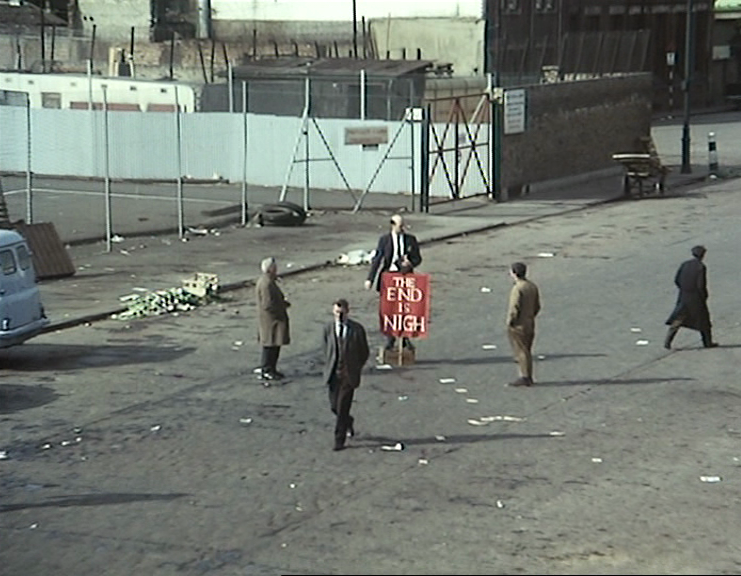
The London Nobody Knows is available as an Optimum Classic DVD as part of a double-bill with Les Bicyclettes de Belsize, and is available here and here (I’m only making life easier if you want a copy – I don’t have any association with these vendors.)
The documentary is also up on YouTube, but it probably shouldn’t be for sorts of copyright issues. The quality isn’t a patch on the DVD.
Patrick Caulfield’s grave in Highgate
May 4, 2011
While everyone knows Highgate Cemetery is full of interesting and noteworthy monuments, I didn’t stumble across this one until 2009.
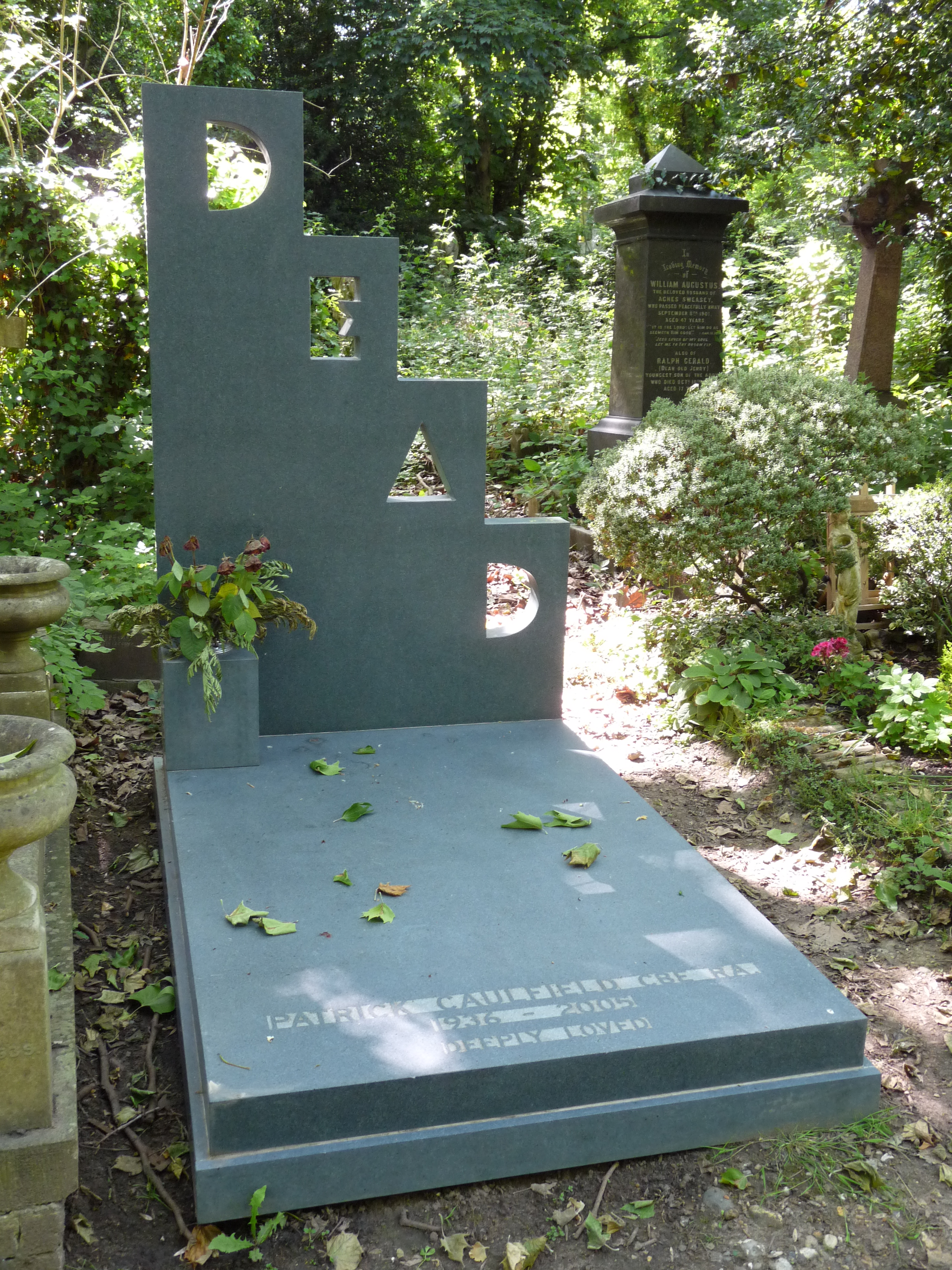
It’s genuinely a surprise when you stumble upon it – you rarely see the word ‘dead’ celebrated in a graveyard, let alone spelled out in huge laser-cut letters on a six-foot slab of granite.
The painter and print-maker Patrick Caulfield (1936-2005) was a contemporary of David Hockney. Regarded as part of the Pop Art movement. and a Turner Prize nominee in 1987, Caulfield designed the memorial which now sits on his grave.
There’s lots of Caulfield’s work available to see online, but if you fancy seeing the grave, it’s in the east side of Highgate Cemetery – down the central road, and almost to the railings at the very end.
Cafe Classique, Colindale
May 4, 2011
It’s long gone now, but here’s a photo I took of Cafe Classique in Colindale back in about 2002. Just outside the tube station on Colindale Avenue and next to the shop dedicated solely to Airfix models (a much sadder, more recent loss), it was the only place near the British Library’s newspaper archive to go for something for lunch.
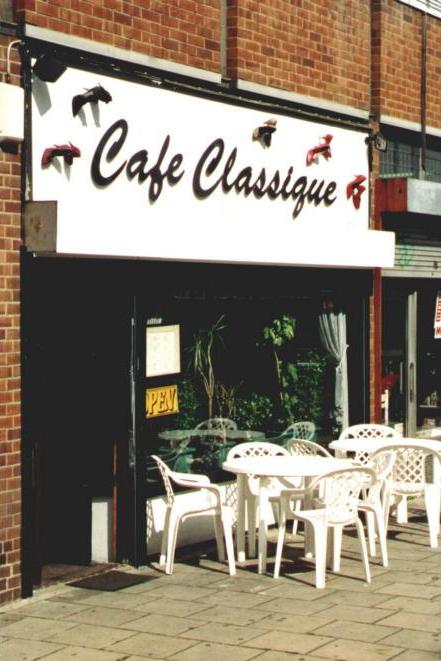
The women’s shoes nailed to the sign might put some people off, but if that didn’t work, someone had also blu-tacked a couple of porn photos up in the gentlemen’s toilets.
The people working behind the counter never seemed very happy to serve, took orders and money begrudgingly and there was always a worrying sense that some of the women who worked there might also be on the game. The academics and writers who’d come out for a break in their research would look terrified the second they crossed the threshold, and they’d always eat quickly, in silence, and get out as soon as possible. There was a constant sense of tension and fear in the room that the employees seemed to actively encourage.
For entirely explicable reasons, Cafe Classique ended up closing down a couple of years later. I took this photo quite early on, but as the months and seasons passed after I’d snapped it, the shoes started to get incredibly tatty – covered in bird shit, torn up, faded in the sun, puckered by the rain. It became the most melancholy looking cafe you’d ever seen in your life.
The shop sign always reminded me of Mike Leigh’s Life is Sweet, where Timothy Spall opens up a restaurant serving dishes like liver in lager which has too many themes going on at once. The shoes are an attempt at panache that overreaches, entirely misses and ends up being excruitiating. And Cafe Classique – I mean, they nailed women’s shoes to the front. What were they thinking?
It’s like some kind of serial killer’s grisly trophy display. You might as well have put scalps up there, or necklaces of teeth.
There is still a cafe on the site today, but, disappointingly, it’s entirely nondescript.
UPDATE – February 2012
Sometimes, the places you’ve always half-wondered about have a history just waiting to be revealed. In February, I was emailed by Ebru, who it turned out knew the cafe well.
I have been crying with laughter reading your musings on the cafe that was indeed classique!
This was my dad’s cafe.
When we saw the shoes and porn and undies nailed to the wall, we were like “WTF!” There is soo much that went on in there, I had forgotten about the black and white classy porn that was hanging in the toilets…
To be fair to my dad, it was an inspirational time for him: he was having an affair with one of his Czech waitresses (she was quite nice), I think he wanted to impress her.I even had a blazing row with him there: I asked for £40 and for the first time he said ‘no’. I started screaming at him and told him to shove his money and spend it on some knickers for his girlfriend… knowing him, he would have nailed a satin twinset to the wall.
He had a cafe in South Oxhey before Colindale. His sexuality was hidden under the counter: he would cut out the Sun’s topless girl everyday and keep it there. I’d have a look through them (interested in what they had to say) and there was a stack! Started recognising them after a while, I was around 10… Brother and myself turned out ok, but it didn’t work out with the Czech girl.He now lives with his brother in Grahame Park (not so much stillettos… more like Werther’s Originals and freedom passes).Thank you for writing about it on your blog. It’s nice to know that his overt sexuality was appreciated by others.
The Men Who Wrote Shakespeare
May 4, 2011
Whether one believes a barely-educated glove-maker’s son from Stratford-Upon-Avon could produce the greatest single body of literature in the history of the world or not (and if you want to find yourself unsure, John Mitchell’s excellent Who Wrote Shakespeare? (1996) will give you plenty of conspiracy food for thought), one fact is unassailable: the man known as Shakespeare didn’t write the plays which we can pick up and read today.
That’s not to say the words weren’t his – but if William Shakespeare ever physically wrote any of those words down, nothing has survived. Instead, the plays we know today as ‘Shakespeare plays’ are the work of two men who have been largely forgotten: the actors John Heminge and Henry Condell.
I say ‘largely forgotten’, but in the City churchyard of St Mary Aldermanbury, EC2, is a memorial dedicated to them both.
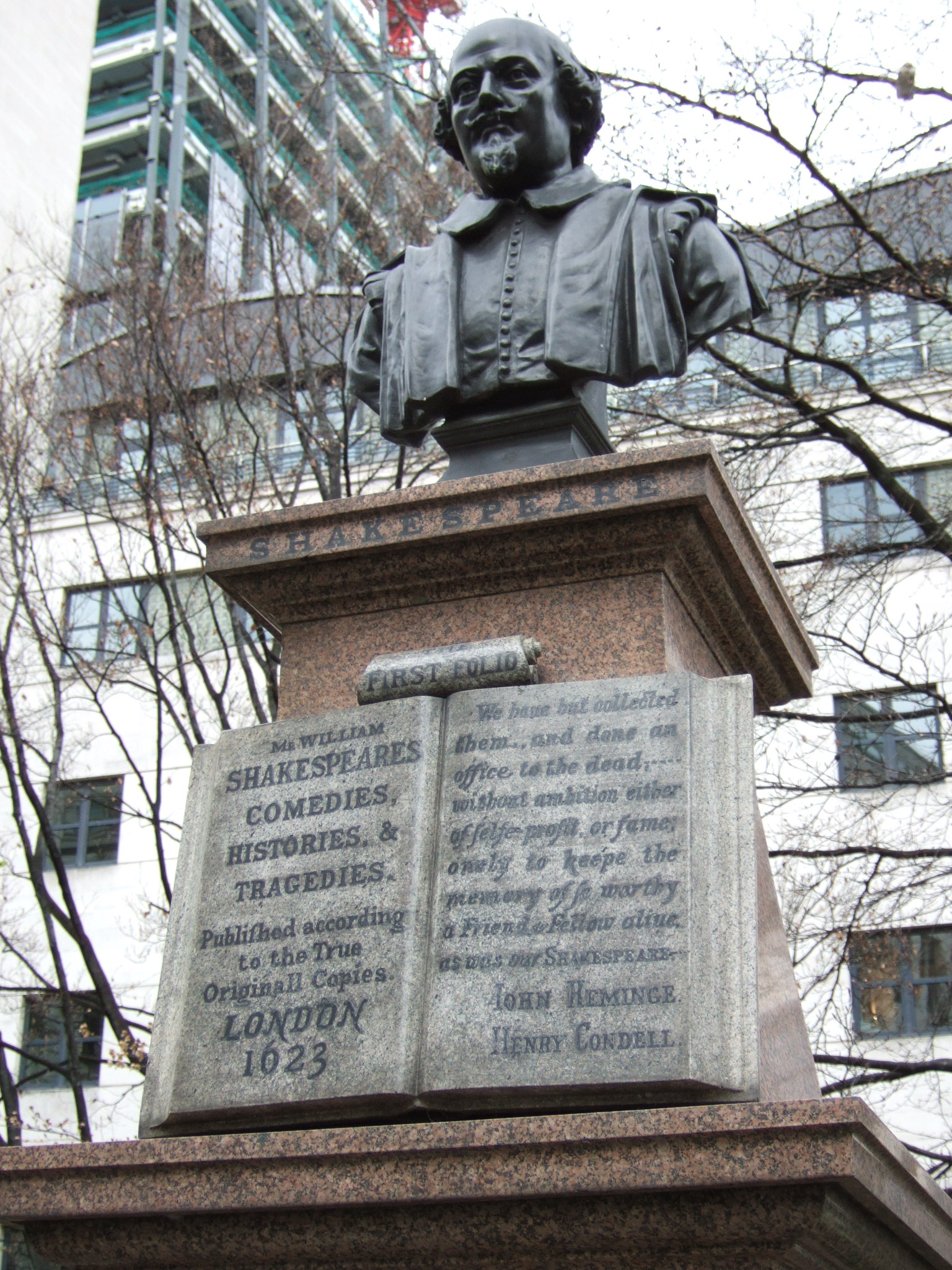
While the bust of Shakespeare sits proudly on top of the memorial, the plaques on the main body are dedicated to Condell and Heminge.

The text reads:
To the memory of JOHN HEMINGE and HENRY CONDELL, fellow actors and personal friends of SHAKESPEARE. They lived many years in this parish and are buried here.
To their disinterested affection the world owes all that it calls SHAKESPEARE. They alone collected his dramatic writings, regardless of pecuniary loss and without the hope of any profit, gave them to the world.
THEY THUS MERITED THE GRATITUDE OF MANKIND.
The two were Shakespeare’s co-partners at the Globe theatre in Southwark, and on his death in 1616
from the accumulated [plays] there of thirty five years, with great labour selected them. No men then living were so competent having acted with him in them for many years, and well knowing his manuscript, they were published in 1623 in Folio, thus giving away their private rights therein. What they did was priceless, for the whole of his manuscripts with almost all those of the dramas of the period have perished.
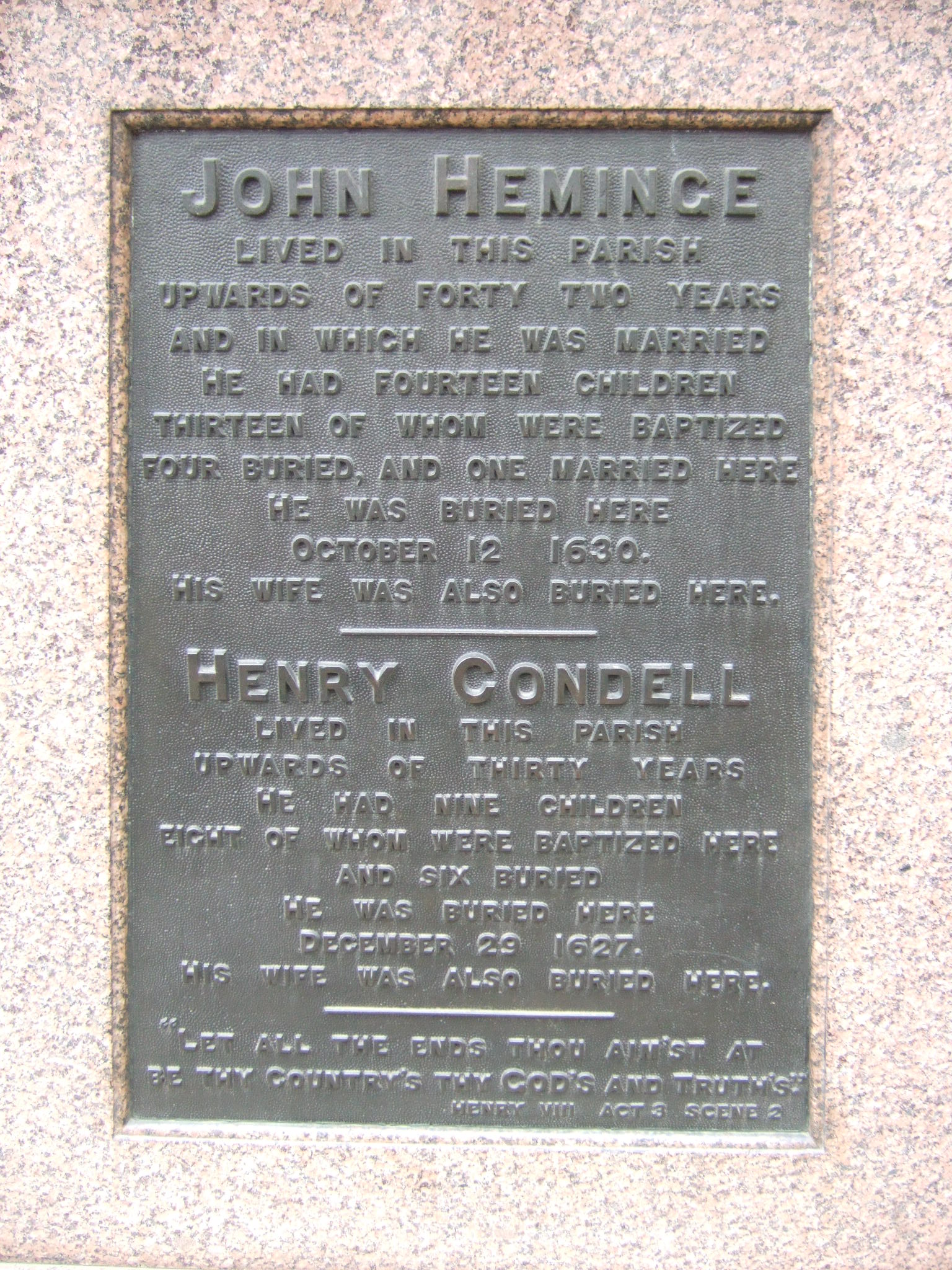
There’s no question of an authorship controversy here. The two men state unequivocably that Shakespeare was the author of the plays at a time when many of his contemporaries were still alive. It is one of the strongest refutations ofthe idea Shakespeare was not their author.
If it wasn’t for Heminge and Condell, the works of Shakespeare could have been lost to the world forever. They were the fine thread between us having the work of the world’s greatest writer and it being lost entirely.
How different the world would be if they hadn’t sat down one day, with a pile of dusty papers and half-remembered passages they’d performed a decade before, and thought, “Well, maybe we should try and get the lot of them written down for posterity.” It starts to make me feel ill at the thought of the great works that have been lost forever simply because there was no Heminge or Condell around to save it.
Everytime someone performs a Shakespeare play, there should be a round of applause at the start for the men who ensured that Shakespeare’s words survived.
The Church of St Mary Aldermanbury no longer stands, but was first mentioned in 1181 and rebuilt by Sir Christopher Wren following the Great Fire of London in 1666. Bombed during the Second World War, the stones were removed in 1966, shipped to America, and the church was rebuilt in the grounds of Westminster College in Fulton, Missouri. It was erected as a memorial to Winston Churchill, who had given his famous ‘Iron Curtain’ speech in the Westminster College gymnasium in 1946.
 Darkest London