O’erwhelmed with gore! The transport death pioneers of Harrow
October 19, 2012
As a child growing up in nearby Hatch End, the gravestone of John Port was always a highlight of a visit to St Mary’s Church in Harrow On The Hill.

On the afternoon of 7 August 1838, Port was a guard on the London to Birmingham train and as it travelled through Harrow, he slipped and fell while walking between the carriages to check tickets. Both his legs were severed as the train went over him and he died later that day from massive blood loss.
The coroner’s inquest found that:
the unfortunate deceased started with the Denbigh Hall five o-clock train on Tuesday last from the station at Euston grove, and having arrived within a mile and a quarter of Harrow, as was the usual custom, he dismounted from his seat for the purpose of collecting from the passengers what is termed the ‘excess fares.’ … In the performance of this duty the deceased was engaged on Tuesday, which compelled him to pass from one carriage to the other by the steps, and when in the act of placing his foot on one of them, at the time the train was proceeding at upwards of thirty miles an hour, his foot slipped between the wheels, which as they successivley passed over, dragged his legs in, crushing them inch by inch up to one of his knees and above the other.
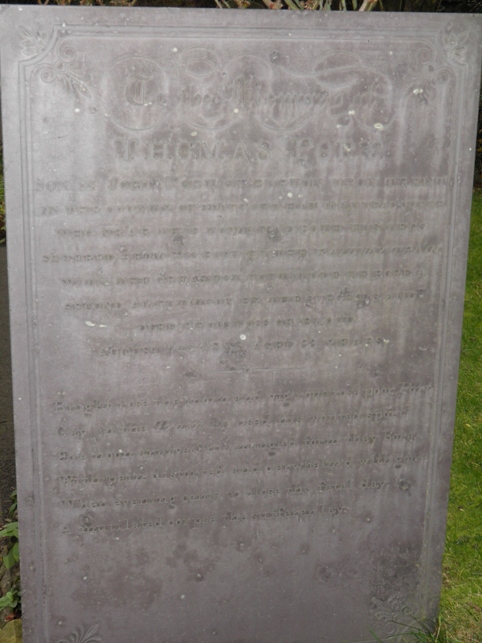
His tombstone bears a gruesome poetic account of the incident.
- TO THE MEMORY OF
- THOMAS PORT
- SON OF JOHN PORT OF BURTON UPON TRENT
- IN THE COUNTY OF STAFFORD, HAT MANUFACTURER,
- WHO NEAR THIS TOWN HAD BOTH HIS LEGS
- SEVERED FROM HIS BODY BY THE RAILWAY TRAIN.
- WITH THE GREATEST FORTITUDE HE BORE A
- SECOND AMPUTATION BY THE SURGEONS, AND
- DIED FROM LOSS OF BLOOD.
- AUGUST 7TH 1838 AGED 33 YEARS.
- Bright rose the morn and vig’rous’ rose poor Port.
- Gay on the Train he used his wonted sport:
- Ere noon arrived his mangled form they bore,
- With pain distorted and o’erwhelmed with gore:
- When evening came to close the fatal day,
- A mutilated corpse the sufferer lay.
Over the years, the headstone has eroded to the point of near illegibility, despite being Grade II listed in 1983.
Port’s death came only eight years after the first ever British rail fatality, that of William Huskisson MP, who died in similar circumstances.

At the opening of the Manchester to Liverpool railway, he “lost his balance in clambering into the carriage and fell back upon the rails in front of the Dart, the advancing engine” which then ran over his leg, severing it. Huskisson died of blood loss, having “lingered in great agony for nine hours.”
Surprisingly, there is also a memorial nearby for another transport-fatality pioneer.
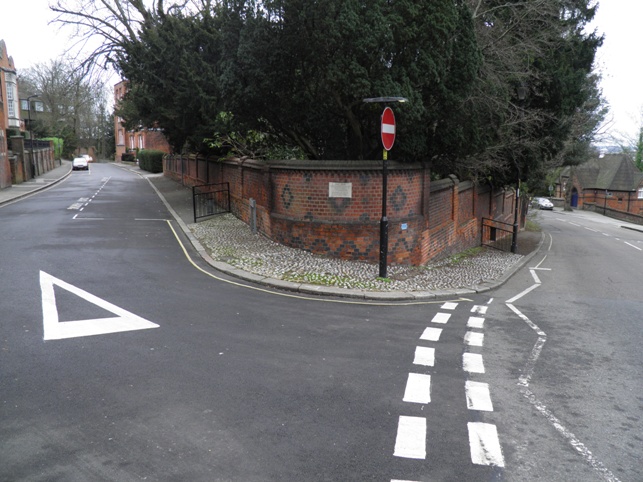
Two minutes stroll down the hill, on the corner of Grove Hill, is a plaque commemorating the first car driver ever to die in a road accident.

The driver, Mr E.R. Sewell had been demonstrating the vehicle, a Daimler Wagonette, to 63-year-old Major James Stanley Richer, Department Head at the Army & Navy Stores, with the view to a possible purchase for the company.As they drove down the hill at 14mph, a wheel shed it’s rim. Both Sewell and Richer were thrown from the car onto the road.

Sewell died instantly, and when Major Richer died four days after the accident without regaining consciousness, it became a dubious double-first – the first death of a driver in Britain, followed by the first death of a passenger in a car
The dubious accolade of being the first person to be killed by a car in Britain goes to Mrs Bridget Driscoll of Old Town, Croydon who on 17 August 1896 was run over by a Roger-Benz car while attending a folk dancing festival at Crystal Palace.
The driver was going at 4 mph (described by witness as “a reckless pace”), and at Mrs Driscoll’s inquest, Coroner William Percy Morrison said he hoped that “such a thing would never happen again.” He was also the first to apply the term ‘accident’ to violence caused by speed.
Since then, some 30 million people have lost their lives in car accidents, but a woman from Croydon is the name which appears at the very top of the list.

