Giro – London’s Favourite Dead Nazi Dog
November 10, 2011
At the top of the Duke of York steps outside number 9 Carlton House Terrace, in a small walled-off enclosure and almost hidden behind the jumble of gardener’s paraphernalia wedged beside it, is the country’s only memorial to a Nazi.
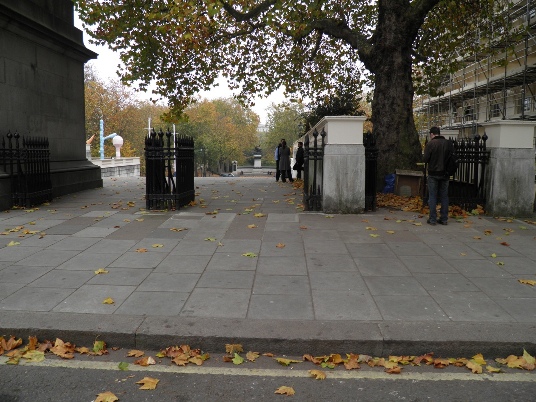
There are mitigating circumstances, however – the most important of which being that this Nazi happened to be a dog.

Shortly after John Nash built Carlton House Terrace between 1827-1832, no.9 became the official residence of the Prussian ambassadors. Prussia House, as it became known, housed diplomats for almost a century before the outbreak of World War 1 forced them all out.
In 1920, however, the ambassadors representing Germany’s new Weimar Republic returned to Prussia House – despite occupation in the intervening years by America and the Swiss, the official history of the German Embassy claims that “everything was found in place as the last Ambassador of Imperial Germany, Prince Lichnowsky, had left it on 6 August 1914, including even the cigarettes in the silver case on the Ambassador’s desk.”
The Weimar Republic’s final chargé d’affaires was 51-year-old Leopold von Hoesch (1881-1936), an old-fashioned diplomat who had become the much-admired German ambassador in Paris after stints in Peking and Madrid.

Von Hoesch did much to improve Anglo-German relations throughout the early 1930s and won the admiration of both of the British foreign secretaries he worked alongside, Sir Anthony Eden and John Simon.
But a year after von Hoesch took up his post in London, the Weimar Republic was no more. In 1933, entirely by proxy rather than choice, von Hoesch became a representative of the Third Reich.
In February 1934, von Hoesch’s beloved terrier Giro died (some reports over the years have claimed he was electrocuted in the garden, but no reliable sources are given) and he was buried in the gardens.

His tombstone bore the inscription:
“GIRO”
EIN TREUER BEGLEITER! (A faithful companion!)
LONDON IM FEBRUAR 1934.
HOESCH.

Two years later, the Ambassador himself died in the bedroom of the house from a stroke. He was only 55, his life seemingly shortened by the strain of maintaining the Anglo-German relations that were being routinely and savagely tested by the new National Socialist ruling party with whom he was increasingly despairing of.
In his obituary – written in April 1936, at a time when the Nazis were already a worrying spectre in the pages of the newspapers each day – The Times celebrated von Hoesch’s traditional, cultured manner.
He spoke beautiful English in soft, modulated tones, and the theme of all his speeches was the cultivation of better Anglo-German relations…though a bachelor, von Hoesch entertained hospitably at the Embassy, and with his sincerity and personal charm made many friends among English statesmen. He had a distinguished bearing and was always particularly well dressed.
The British Government, in accordance with international diplomatic protocol, effectively gave him a state funeral on his way to the Dover-bound train from Victoria Station. The cortege was led by Grenadier Guards, British government ministers formed part of the funeral procession, and von Hoesch received a 19-gun salute in St. James’s Park bidding him farewell.
Some startling newsreel footage was taken as the funeral procession made its way down the Mall. At the top of the Duke of York steps, German Embassy staff gave the Nazi salute as von Hoesch’s coffin, wrapped in a swastika flag, headed out of Carlton House Terrace towards Buckingham Palace.
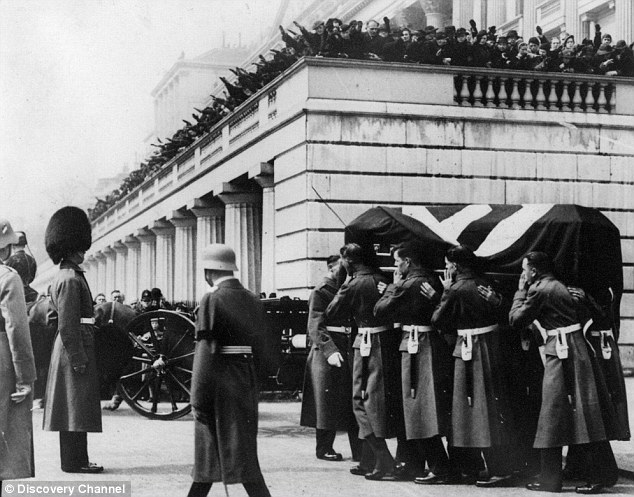

The coffin was taken to Germany on the British destroyer HMS Scout. After the triumphant display in London, not a single representative of the Nazi Party attended von Hoesch’s funeral in Berlin. And the next German ambassador couldn’t have been more different from the soft-spoken, charming von Hoesch.
Joachim von Ribbentrop was a key member of the Nazi regime, and while his time in London was short (he was back in Germany within a year), some of the more intriuging stories associated with his stay have proved impossible to confirm or deny.

It is known that Albert Speer oversaw the modernisation of No.9 Carlton House Terrace, but whether he also created a vast swastika mosaic on one of the floors has never been verified (it supposedly remains there to this day, hidden underneath the carpet.) Completely true is that while in London, Von Ribbentrop’s son Rudolf briefly attended Westminster School, where his classmate was Peter Ustinov.
But back to Giro, the unwilling Nazi (if we can entirely forget he was a dog, Giro was more correctly a member of the Weimar Republic.)
None of articles in The Times during von Hoesch’s life or at the time of his death mention either the dog or the gravestone. In fact, the first mention of Giro is to be found in a small news item in December 1966.
At the time, builders were excavating a strip of land in front of no.9 Carlton House Terrace to create a deep underground car park which now cuts between the small patch of ground the gravestone is on and the building. A German man walking down the Duke of York steps noticed the gravestone propped up underneath one of the trees and recalled that von Hoesch was the former ambassador.
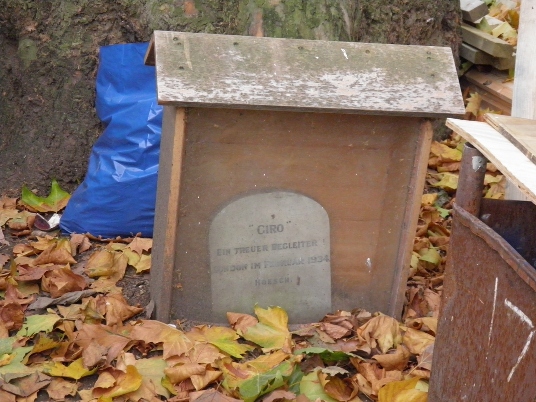
It seems likely that the gravestone was picked up from the gardens of the house by a builder as the excavations took place. Not wanting to see the little gravestone destroyed, he placed where it now stands today. At some point in the 1990s, the strange kennel with the misty plexiglass plastic front was fitted over the top to protect it from damage.
But however it got there, one thing is certain; wherever Giro’s mortal remains are now, they’re certainly not underneath that stone.
But I can’t help but feel that’s just as well. It means that little tombstone’s not simply a marker of where a dog is buried, but becomes something much bigger. It’s a memorial not just to a dog that was loved by its master, but to von Hoesch himself – and a testament to how love ultimately endures as hate withers.
When Von Ribbentrop looked out of the windows of 9 Carlton House Terrace in 1936, he may have envisaged a day when memorials to the Nazis covered the whole of London.
Hanged for war crimes a decade later, he probably never imagined that the last vestige of the regime he dedicated his life to would be the gravestone of a terrier that was already sitting in his back garden.

The burning of Lord Byron’s diaries
November 9, 2011
From 1768 until it was finally sold in 2002, Britain’s most famous publisher was run by a man by the name of John Murray.
John Murray wasn’t a single man – but seven men from the same family all of whom bore the same name (they are differentiated by a number, I to VII.) All but the first John Murray operated from a building at 50 Albemarle Street, Piccadilly, the outside of which still bears their name a decade after the company was bought and absorbed into Hodder Headline.

Renowned as an uncanny spotter of literary talent, John Murray II (1778-1843) moved the firm his father had started from Edinburgh to Albemarle Street in 1812, a year after he began publishing the works of Lord Byron (1788-1824).
 John Murray II
Byron’s epic poem Childe Harold’s Pilgrimage had been an instant sensation, selling out in just five days and turning the 24-year-old into a superstar of the age. In Byron’s own words, “I awoke one morning and found myself famous.” For the whole of his life and for many centuries afterwards, he was simply regarded as the greatest poet the world had ever known.

The publisher and the poet met for the first time in the upstairs drawing room of the offices – a room which would later play host to one of the most infamous incidents in the history of lost English literature.
As the 1820s advanced, so too did the fortunes of Murray’s firm. He published Jane Austen – Emma, Northanger Abbey and Persuasion – along with Washington Irving and Sir Walter Scott. His regular afternoon teas at the house – known as “Four O’Clock Friends” – ensured the house became a meeting point for the biggest and brightest names in literary London.
For Byron, however, the passing years had not been so profitable. His name had become associated with whispered allegations throughout society of sexual promiscuity, affairs with married women, siring illegitimate children, homosexuality, sodomy and even incest – and the whispers were getting louder. In 1816, Byron left England for good, spending the last eight years of his short life in exile abroad.
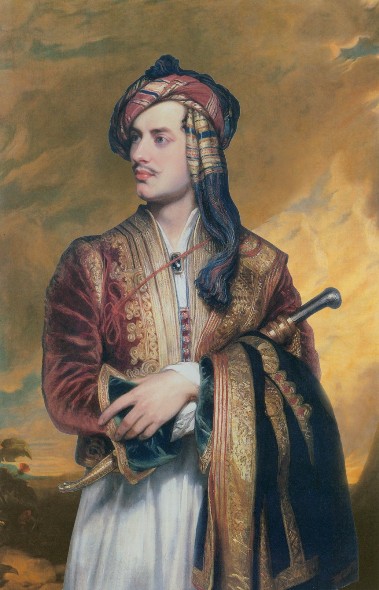 Byron in Albanian dress, 1813
Byron died in Greece in 1824, struck down with a fever while leading a troop of soldiers against the Ottoman Empire in the War of Greek Independence. In death, the formerly scandalised Byron became a hero, celebrated for his passion, untamed nature, arrogance, wilfulness, tortured soul, tangled love-life and untimely death. Not just the template for the Romantic hero, Byron’s very name became a by-word for the noble virtues and tragic flaws he encapsulated.
Once his body was shipped back to England (with rumours rife that his heart had been removed and buried in Greece), he was refused burial at Westminster Abbey, who cited his “questionable morality.” One of the greatest of all English poets, Byron wasn’t even awarded a memorial in the Abbey until 1969.
With the doors of the Abbey closed to him, a long funeral procession was organised to take his body from London to Hucknall in Nottinghamshire (close to his ancestral home, Newstead Abbey.) As Byron’s body passed through Highgate, the cortege was witnessed by his elderly contemporary Coleridge, who was standing alongside the young pharmacist’s assistant from whom he made his regular, surreptitious purchases of opium.
On 17th May 1824, a month after Byron’s death, John Murray would participate in one of the most notorious acts in the annals of literature in the upstairs drawing room of 50 Albemarle Street.
During his exile in 1822, Byron named the Irish poet Thomas Moore (1779-1852) as his literary executor and handed him a manuscript of his personal memoirs which he wanted to be published at a later date.
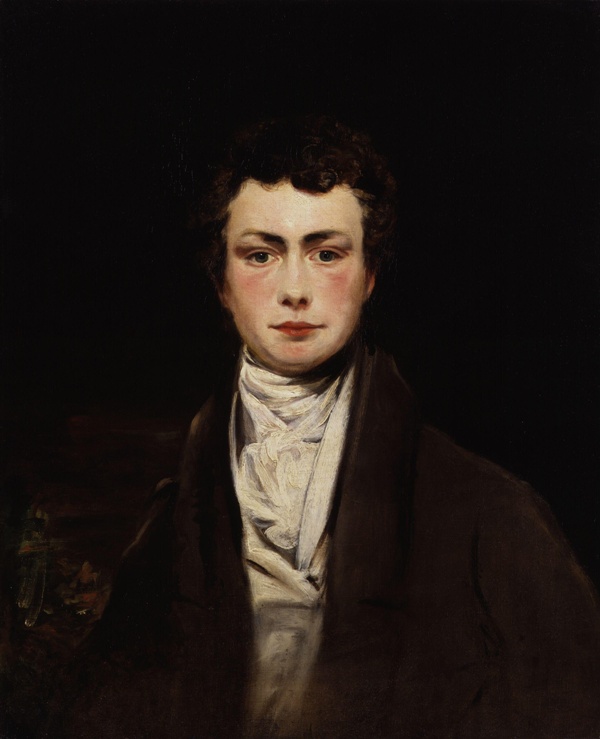 Thomas Moore
But with Byron dead, and the public clamouring for anything bearing his name, Murray made a decision. Having been presented with the two volumes of Byron’s memoirs by Moore, he decided he had to act.
Byron’s memoirs had to be destroyed.
With the agreement of five of Byron’s friends and executors of his will (and with the only opposition coming from Moore), the men set about pulling apart the pages and burning the pages in the fireplace of the drawing room.
Whatever Byron had written, Murray believed the memoirs were so scandalous they would forever damage Byron’s reputation, and possibly his own should he ever publish them. Even Moore, who in 1832 wrote a biography of Byron and was heavily criticised for allowing the memoirs to be destroyed, never divulged their contents.
Of what Byron wrote, which shocked Murray so deeply, we know only one thing; it left the house at Albemarle Street via the chimney.

In destruction, Byron’s memoirs gained infamy; they became the most celebrated work of literature that no-one would ever read.
For centuries afterwards, a massive portrait of Byron has been hanging above the very fireplace which rendered his final words into silent spots of ash and soot.
 John Murray VI in front of the Byron portrait…and fireplace
 Darkest London